Can Dogs Eat Apples? A Neurologist's Take on Fruit, Fiber, and the Parts to Skip
A board-certified veterinary neurologist walks through whether dogs can eat apples safely, from puppyhood through the senior years, and explains why the seeds and core are the real risk.
Yes, dogs can eat apples in moderation — the flesh is a fine snack, but the seeds and core deserve real caution.
On this page
The first time I remember a client asking me about apples wasn’t in the neurology suite at all. It was in a parking lot, a woman with a young Aussie mix on a slip lead, watching her dog eye the core she’d just finished eating. “He wants the rest,” she said, half-laughing, half-worried. “Is that a problem?” I told her what I still tell people: the flesh is fine, the core isn’t, and the difference matters more than most owners assume.
Apples come up constantly in whole-dog conversations because they sit at an odd intersection — genuinely useful fruit, genuinely misunderstood risk. So let’s walk through it the way a dog actually experiences apples: across a life, not as a single yes-or-no.
A Puppy’s First Bite of Apple
A puppy’s gut is still calibrating. It hasn’t built the steady rhythm an adult dog’s digestion runs on, so anything new gets introduced in small amounts and watched closely. A sliver of seedless, cored apple is a low-stakes way to expand a puppy’s palate beyond kibble and training treats. I don’t reach for it as a first food, though — I reach for it as a second or third one, after a puppy has shown it tolerates simple new foods without loose stool. If you’re building out a broader routine for a young dog, our Whole-Dog Wellness: A Practical Starting Guide walks through that sequencing in more depth than I can here.
What I don’t do is treat a puppy’s enthusiasm as permission. Puppies chew through cores and stems with more determination than judgment, and that’s exactly the combination that ends up in an exam room.
Adult Dogs and the Daily Treat Question
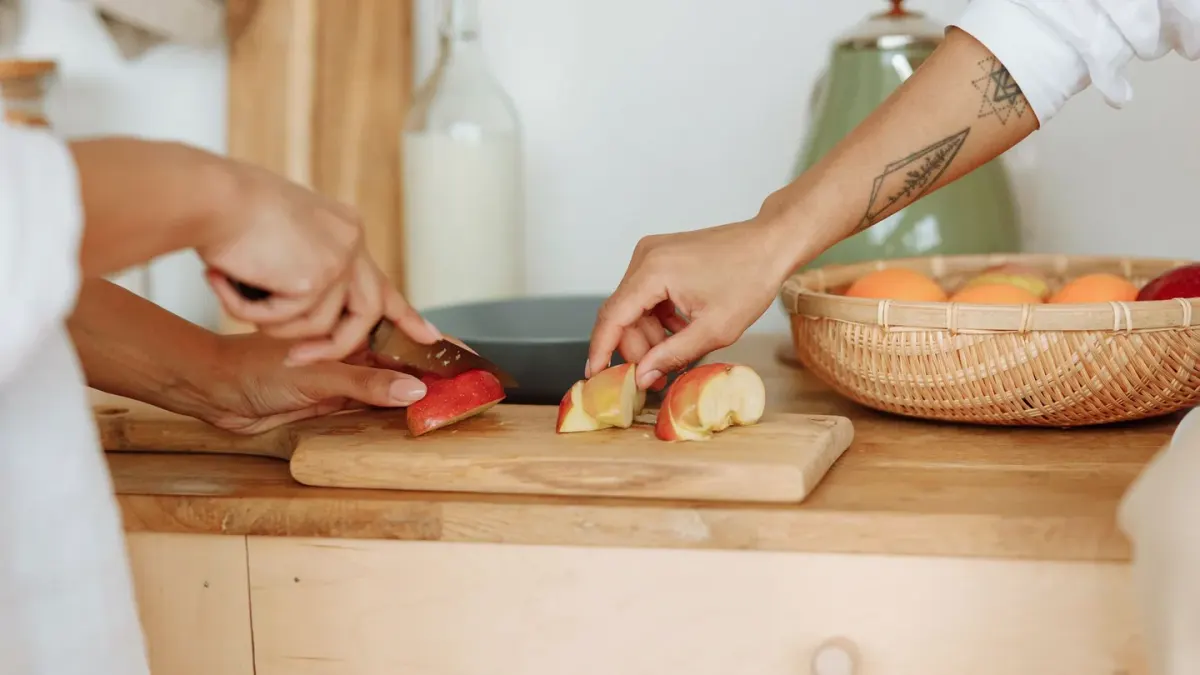
By adulthood, most healthy dogs handle apple flesh without drama. It’s low in fat, carries real fiber, and gives owners something crunchy and low-calorie to use in training or as a stand-in for a biscuit. According to PetMD, apples provide fiber, vitamin C, and other nutrients, and are generally considered a healthy treat when fed appropriately. That lines up with how I use them clinically — as a rotation item, not a daily fixture.
Where I get firm is portion. Apples, like any treat, should stay under roughly 10% of a dog’s daily calorie intake, per AKC guidance, and that ceiling matters more in dogs already managing weight. In my integrative work, I think about apple the way TCVM food therapy frames most fruit — a cooling, moistening addition to the diet, useful in the right dog and season, not a therapeutic cornerstone. I reach for both the imaging study and the acupuncture needle in my own practice, and that same instinct applies here: use the tool that fits the actual question in front of you, not the one that’s trendiest.
I think about this most concretely with dogs managing diabetes. Owners often ask whether fruit is off the table entirely once a diagnosis lands. It isn’t automatically, but it isn’t a free pass either. Veterinary Partner (VIN) resources on diabetic dog diets emphasize that any treat, apples included, needs to fit within a vet-supervised feeding plan rather than being added on top of it. I’ve had this exact conversation more than once with an owner standing in my exam room holding half an apple, genuinely unsure if kindness and good medicine were pulling in different directions. They usually aren’t — they just need a portion size and a vet’s sign-off, not a blanket ban.
What Changes in the Senior Years
Older dogs are where I get the most questions, and honestly, where I get the most cautious. Chewing changes with dental disease and arthritis in the jaw and neck can make a whole slice harder to manage than owners expect. I’ll often suggest thinner slices or a light mash instead of wedges for a dog past ten or eleven, simply because the mechanics of eating have shifted even when appetite hasn’t.
Senior dogs are also more likely to be carrying a diagnosis — kidney changes, diabetes, weight concerns — that puts a ceiling on how much sugar and fiber makes sense on a given day. None of that makes apple off-limits. It does mean the decision belongs to whoever is already managing that dog’s chronic condition, not to a general feeding guideline.
The Parts That Don’t Belong in the Bowl
Here’s where I stop hedging. Apple seeds contain amygdalin, a compound that releases cyanide during digestion, and while a dog would need to chew through a genuinely large number of seeds to reach a dangerous dose, there’s no reason to let any of them ride along in a treat. Remove them, every time, without exception.
The core and stem are the more common real-world problem. They’re tough, fibrous, and roughly the wrong shape for a dog’s throat — a classic setup for choking or, in smaller dogs, intestinal obstruction. I’ve walked owners through what to watch for after a dog snatches a core off a counter: gagging, repeated swallowing, retching without producing anything, or a sudden reluctance to eat. None of those are apple-specific symptoms, but they’re the ones that get a same-day call to your vet rather than a wait-and-see approach.
My Verdict, Life Stage by Life Stage
Apple flesh is a genuinely reasonable treat across a dog’s life — sliced thin for a puppy testing new foods, offered in modest amounts to a healthy adult, mashed or thinned for a senior with dental or metabolic limits. The seeds and core are non-negotiable removals in my book, not a matter of personal risk tolerance. And for any dog already managing diabetes, kidney disease, or significant weight issues, apple is a conversation to have with your own veterinarian before it becomes a habit, not after.
Frequently asked questions
Can puppies eat apples?
Small, seedless, cored slices are generally fine as an occasional treat once a puppy is eating solid food, but introduce any new food gradually and watch for loose stool.
Is apple skin safe for dogs?
Yes, the skin itself isn't the concern — the seeds and tough core are what to remove before serving.
Can dogs eat apple sauce or apple pie filling?
Plain, unsweetened apple sauce with no added sugar or xylitol can work in small amounts; sweetened versions and pie filling usually carry more sugar and additives than a dog needs.
Sources
- Can Dogs Eat Apples? How to Safely Feed Apples to Dogs — AKC
- Can Dogs Eat Apples? Benefits and Risks — PetMD
- Diabetic Dog Diet — Veterinary Partner (VIN)