Can Dogs Eat Broccoli? A Neurologist's Honest Take on Portion, Prep, and Risk
Broccoli is safe for most dogs in small amounts, but the florets carry a compound that can upset the gut. Here's how to feed it without the downside.
Yes, dogs can eat broccoli in small, plain amounts, but the florets carry a compound that punishes overfeeding fast.
On this page
Late spring, a client brought in her twelve-year-old spaniel mix for a gait recheck, and while we talked she mentioned, almost as an aside, that she’d started tucking steamed broccoli into his bowl because she’d read it was “good for aging joints.” He’d had two loose stools that week. Nothing dramatic, no lethargy, no vomiting, but enough that she’d started second-guessing every meal. It’s a scene I hear some version of often: an owner reaching for a vegetable that sounds virtuous, without a clear sense of how much is a treat and how much is a variable their dog’s gut has to absorb.
The short answer is that broccoli is not dangerous to dogs in the way a grape or an onion is. It won’t send a healthy adult dog into a diagnostic crisis. But it is not neutral either, and the honest version of this guide has to hold both of those things at once.
What’s actually in a floret
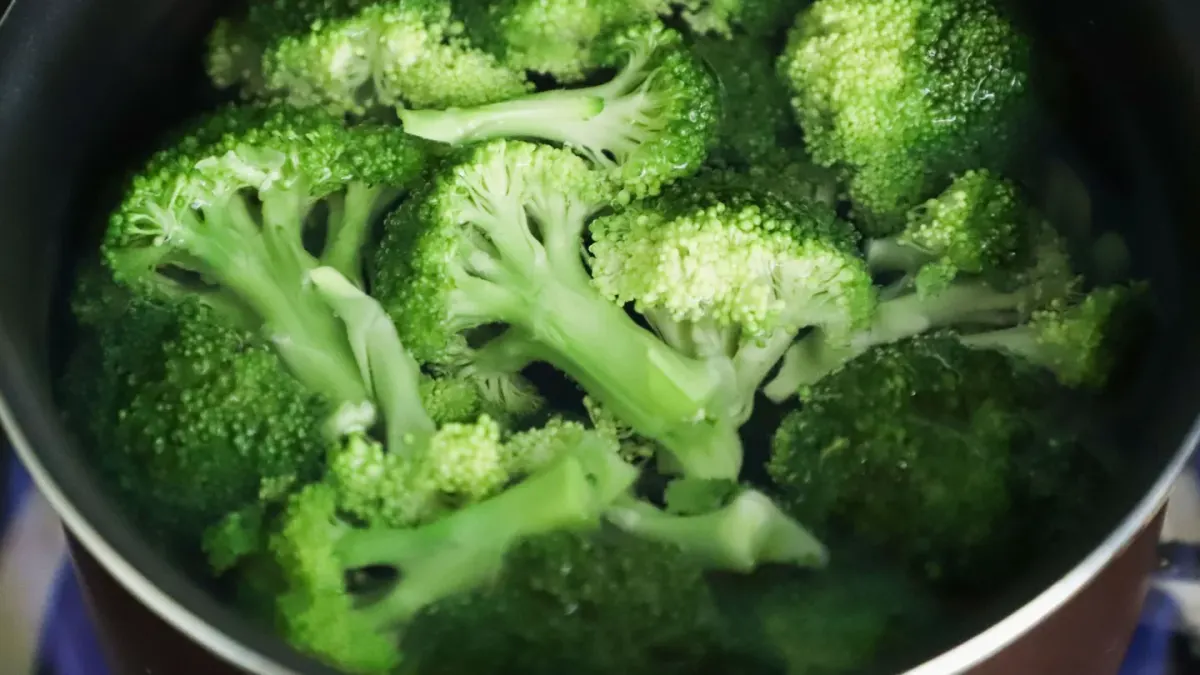
Broccoli florets contain isothiocyanates, plant compounds that give cruciferous vegetables their characteristic bite and, in dogs, can irritate the digestive tract when eaten in any real volume. This is the mechanism behind almost every bad broccoli story an owner tells you: gas, softer stool, occasional vomiting, all traceable back to a gut lining that got more of this compound than it was ready to process. It is not a toxin in the sense of causing organ damage. It is closer to a threshold effect, mild in small amounts and unpleasant past a certain line.
That line has a widely cited number attached to it. Guidance from the American Kennel Club puts the safe ceiling at roughly 10% of a dog’s total daily food intake, with amounts climbing toward a quarter of daily intake carrying meaningfully higher risk. For most dogs that works out to a floret or two, not a side dish, and definitely not a daily habit dressed up as a supplement.
The stalk is a different problem entirely
Owners often assume the stem is the safer, more “vegetable-y” part, since it lacks the fringed texture of the floret. In fact the stalk carries more fiber than the floret, which is nutritionally fine, but its density creates a mechanical risk that has nothing to do with isothiocyanates: dogs that gulp food rather than chew it can choke on a chunk of raw stem, or in rarer cases develop a partial obstruction from a piece that’s too big to pass easily. Cut small. Steamed until it gives slightly under a fork is safer than raw and dense.
I think about this the same way I think about a dog presenting with an intermittent neurologic sign: the mechanism matters as much as the outcome. A dog vomiting from isothiocyanate overload and a dog choking on stalk are two different failure modes wearing the same worried owner’s description. Knowing which one you’re managing changes what you do next — cut the portion, or cut the piece size.
Where broccoli sits next to the rest of the gut picture
I’d rather a dog’s baseline digestive resilience come from consistency than from any single ingredient, broccoli included. A gut that’s already working overtime, whether from a chronic condition or from a diet that changes week to week, has less margin for a new variable. In dogs with exocrine pancreatic insufficiency, for instance, Journal of the American Veterinary Medical Association: pancreatic enzyme replacement therapy, nutritional management with low-residue diets, and cobalamin supplementation are the core interventions, and researchers studying that condition have noted that further work is needed to understand the persistent dysbiosis some of these dogs show even after enzyme therapy begins. That’s a far more serious clinical picture than an occasional floret causing gas, but it’s a useful reminder that the gut microbiome doesn’t reset instantly just because a supportive treatment has started.
That same nuance shows up in probiotic research. A recent trial in Frontiers in Veterinary Science found that diversity metrics did not distinguish non-responders from responders when dogs were given a fecal microbiota intervention, which tells us the field still doesn’t have a tidy stool-sample explanation for why one dog’s gut settles quickly and another’s doesn’t. I bring this up not to overstate what broccoli is doing, but to underline why I’d rather owners build a stable dietary baseline first and treat novel vegetables as a minor addition, not a project.
Here’s the scene that sticks with me more than the spaniel’s loose stool: a Lab-mix client of mine, food-motivated to a fault, whose owner had been steaming broccoli every night as a “healthy” replacement for his usual training treats. He was fine on the small amounts, right up until a holiday week when the portions crept larger and more frequent, and he arrived with two days of soft stool and noticeably less interest in his breakfast. Nothing that needed imaging or bloodwork, just a gut that had been quietly asked to do more than it was built for. The fix was almost anticlimactic: pull the broccoli back to a token amount twice a week, and within three days he was back to normal. It wasn’t a broccoli problem so much as a portion-creep problem, the kind that happens gradually enough that an owner doesn’t notice until the dog’s stool does the noticing for them.
A gut under strain from a novel food, even a mild strain, benefits from the same fundamentals that support digestion generally: a well-tolerated fiber source and a stable feeding rhythm. Pumpkin fiber, for instance, is a gentle, natural source of both soluble and insoluble fiber, which is one reason vets often reach for it as a bland stopgap when a dog’s stool has gone soft, broccoli-related or not. And more broadly, a balanced gut microbiome supports overall immune function, which is exactly why I’d rather owners protect that baseline with consistency than chase it with a rotating cast of trendy vegetables.
My actual recommendation
If a dog tolerates it, a floret or two of plain steamed broccoli, cut small, offered once or twice a week, is a reasonable low-calorie way to vary a training-treat rotation. I’d steer clear of raw stalk for dogs that don’t chew carefully, skip any seasoning, oil, or garlic-butter preparation entirely, and back off immediately if a dog shows gas, loose stool, or reduced appetite after eating it. That’s not hedging for the sake of hedging. It’s the same logic I apply everywhere in this field: match the intervention to the mechanism, and don’t let a food that “sounds healthy” quietly become a bigger share of the diet than it was ever meant to be.
If you’re building out a broader plan for daily feeding, exercise, and the small habits that actually move the needle on a dog’s long-term health, our Whole-Dog Wellness starting guide is a good next stop — vegetables like broccoli are a minor lever compared to the fundamentals covered there.
Frequently asked questions
Can dogs eat broccoli stems, or only the florets?
Dogs can eat broccoli stems, and the stems actually carry more fiber than the florets. The tradeoff is texture: raw stems are dense and fibrous, which raises the choking and blockage risk in dogs that gulp their food, so cut them into small, thin pieces or steam them soft before serving.
How much broccoli is safe for a dog in one sitting?
A widely cited guideline from the American Kennel Club (AKC) is to keep broccoli under 10% of a dog's total daily food intake, with amounts above roughly 25% considered risky. In practice that's a floret or two for a small dog and a small handful for a large one, offered as an occasional topper rather than a daily side dish.
Why does broccoli upset some dogs' stomachs more than others?
Broccoli florets contain isothiocyanates, plant compounds that can irritate the digestive tract when a dog eats too much at once. Individual tolerance varies with gut sensitivity, portion size, and how the broccoli is prepared, so a dog that handled a small amount fine last week can still react to a larger one this week.
Is raw or cooked broccoli better for dogs?
Either can work if it's plain, unseasoned, and cut small. Cooking (steaming, no oil or salt) softens the fiber, which many dogs digest more comfortably than raw florets or stems, and it reduces the choking risk that comes with dense raw stalk.
Sources
- Can Dogs Eat Broccoli? — American Kennel Club
- Diagnosis and management of exocrine pancreatic insufficiency in dogs — Journal of the American Veterinary Medical Association
- Fecal microbiota transplantation outcomes study — Frontiers in Veterinary Science