Can Dogs Eat Popcorn? A Vet's Take on Kernels, Toppings, and Movie-Night Sharing
A board-certified veterinary neurologist walks through what actually happens when a dog eats popcorn — kernels, hulls, butter, and the toppings that change the risk — plus a safer way to share the bowl.
Yes, dogs can eat popcorn — but only plain, air-popped kernels in small amounts, with the hulls and toppings removed.
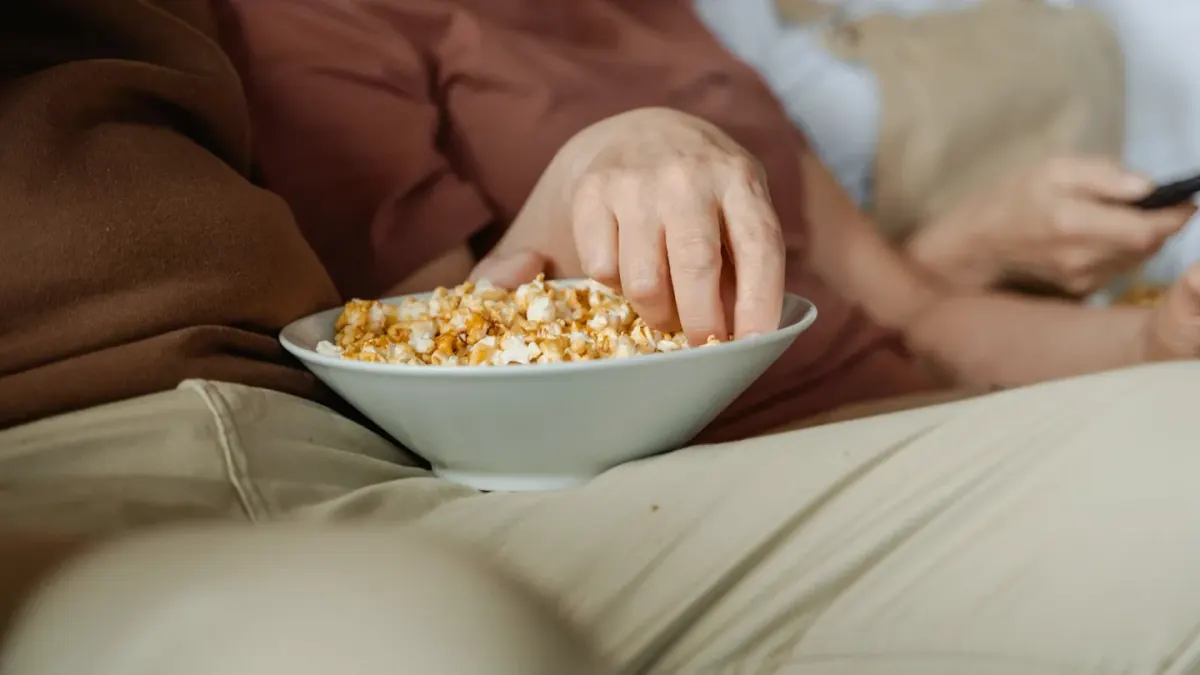
It’s a Friday night ritual in a lot of houses: the bowl comes out, the lights dim, and a dog who has been dozing all evening suddenly materializes at the edge of the couch cushion. I’ve watched this exact scene play out with my own dogs more times than I can count — the fixed stare, the patient chin resting on a knee, the soft huff when a piece finally drops. It’s an easy moment to want to say yes to. The trouble is that “popcorn” isn’t one food — it’s at least four, depending on what’s on it, and only one of those four is worth sharing with a dog.
Let’s start with the plain version, because that’s the one that actually clears the bar. Air-popped popcorn, with nothing added, is mostly a carbohydrate delivery system with a bit of fiber and a modest scattering of minerals. It isn’t a health food for dogs, but it isn’t a threat either, and that distinction matters more than most treat conversations acknowledge. According to the American Kennel Club, plain popcorn in moderation is generally considered safe, and popped kernels do carry trace amounts of magnesium, manganese, phosphorus, and zinc. None of that is a reason to build a feeding plan around it — it’s just context for why the plain version, in small amounts, isn’t the thing I’d worry about.
What I do worry about is the piece that never popped. A whole or partially popped kernel is dense, hard, and roughly the wrong shape for a dog’s digestive tract to handle gracefully. It can wedge between teeth, sit against a gum line, or — in a small dog, or any dog that swallows without much chewing — travel further and get stuck. That’s a mechanical problem, not a nutritional one, and it’s worth naming plainly rather than folding it into vague warnings about “popcorn being risky.” The corn itself isn’t the hazard; the shape and hardness of an unpopped kernel is. Per PetMD, kernels can be difficult for dogs to digest and, in some cases, contribute to gastrointestinal blockages that require surgical correction — which is precisely the kind of outcome that starts as an ordinary evening on the couch.
I think about a scenario I hear versions of often enough that it’s worth walking through in detail, even though it isn’t one specific patient I’m recalling. A ten-pound terrier mix spends the evening working the floor under the coffee table, methodically finding every stray kernel the humans missed. Nobody notices until the next morning, when she skips breakfast and seems unusually quiet on her walk. By that afternoon she’s retching without bringing anything up, and her owner is on the phone with the clinic describing a dog who normally inhales her food and now won’t touch it. That’s not a dramatic story — it’s a mundane one, which is exactly why it matters. The dogs most likely to get into trouble with popcorn aren’t the ones who steal a handful once; they’re the ones who quietly clean up the floor after everyone else has gone to bed, and small-bodied dogs have the least margin for a kernel that doesn’t pass on its own.

Toppings change the equation entirely, and this is where I’d draw the firmest line. Butter and oil add fat that a dog’s pancreas isn’t necessarily built to absorb in a lump sum, and repeated exposure is a recognized contributor to pancreatitis risk. Salt, in the quantities used on shared or theater popcorn, can push sodium intake well past what’s appropriate for a dog’s size. And sweetened versions — kettle corn, caramel corn — introduce sugar at minimum and, in sugar-free formulations, sometimes xylitol, which is genuinely dangerous to dogs even in small amounts. Hill’s Pet and Purina both flag butter, salt, and flavored coatings as the parts of the bowl to keep away from dogs, not the popped corn itself. I’d put it this way: the corn is the part I’m least worried about, and everything we add to make it taste better to us is the part I’d actually screen out.
So where does that leave a reasonable movie night? Pop a portion plain, set aside a small handful before anyone reaches for butter or salt, and let it cool before offering it. Skip kernels that didn’t fully pop — don’t try to sort them out by eye in a dim room; when in doubt, toss the batch and start a fresh one. Treat it the way you’d treat any extra in a dog’s day: it should stay a small slice of the overall diet, not a nightly habit, since the same 10%-of-diet ceiling that applies to jerky or cheese applies here too. If your dog has a history of pancreatitis, a sensitive gut, or is small enough that a single kernel is a meaningful fraction of their throat diameter, the simplest and safest answer is to skip popcorn altogether and reach for something built for dogs instead.
This kind of everyday judgment call — what’s actually worth sharing, and what’s just habit dressed up as affection — is really the whole game in whole-dog wellness. If you’re building out that foundation from scratch, our Whole-Dog Wellness: A Practical Starting Guide walks through the levers that move the needle before any snack or supplement question even comes up. Popcorn will keep showing up in movie-night routines because sharing food is part of how we bond with dogs, and that’s fine. The job isn’t to eliminate the ritual — it’s to know which piece of it is actually doing the dog any favors, and which piece is just habit we haven’t looked at closely.
Frequently asked questions
Is movie-theater popcorn ever okay for dogs?
I'd skip it. Theater popcorn is typically cooked in oil, loaded with salt, and sometimes finished with butter-flavored topping — a combination that stacks sodium and fat onto a stomach that isn't built for either in that volume.
My dog swallowed a few unpopped kernels — what now?
Watch for vomiting, straining, lethargy, or loss of appetite over the next 24–48 hours, which can signal a kernel is stuck rather than passing. A small dog or a dog with a history of gut trouble deserves a lower threshold for calling your veterinarian.
Is caramel corn or kettle corn different from plain popcorn?
Yes — meaningfully so. Both add sugar, and some sugar-free versions substitute xylitol, which is dangerous for dogs in even small amounts, so treat any sweetened popcorn as off-limits rather than a smaller version of the same treat.
Sources
- Can Dogs Eat Popcorn? — American Kennel Club
- Can Dogs Eat Popcorn? — PetMD
- Can Dogs Eat Popcorn? A Guide to Safety — Purina
- Can My Dog Eat Popcorn? Which Flavors are Safe? — Hill's Pet