Fear of Hats, Umbrellas, and Novel Objects: Why Dogs Startle at Ordinary Things
A vet explains why dogs panic at umbrellas, hats, and other harmless objects, and what actually helps — from body language to structure/function support.
Most dogs who bolt from an open umbrella aren't being dramatic — they're reacting to a sudden change in silhouette and sound that their brain hasn't filed under "safe" yet, and the fix starts with how you introduce the object, not with a gadget.

On this page
- What’s actually happening when a dog spooks at a hat or umbrella
- Reading the body before you read the behavior
- What actually helps: desensitization and counterconditioning, done slowly
- Where diet, exercise, and daily structure fit into the picture
- Where structure/function calming support can genuinely help, and where it can’t
- A short case that changed how I frame this for owners
- The bottom line
A client once brought in a three-year-old shih tzu named Mochi, twelve pounds, who had started refusing to walk past the hall closet where the umbrellas lived. It wasn’t the closet. It was that her owner had opened one indoors the week before, during a sudden downpour, and the dog had never fully come back down since. Mochi would freeze at the end of the hallway, ears pinned, tail tucked so tight it curled under her belly, and no amount of coaxing with treats got her past that stretch of floor for nearly three weeks.
This is a genuinely common presentation, and it’s rarely about the object itself. Dogs are built to notice sudden changes in silhouette, sound, and movement long before they register what the thing actually is. A closed umbrella is a stick. An open umbrella is a stick that has become, in the span of half a second, a large moving canopy that snaps and changes the shape of a familiar human. A hat can shift the outline of a face your dog relies on to read intention. Neither is dangerous, but the visual and auditory jump is exactly the kind of stimulus that trips a dog’s threat-detection system before slower, learned reasoning has a chance to catch up.
What’s actually happening when a dog spooks at a hat or umbrella
Dogs rely heavily on shape recognition, motion, and sound to categorize the world as safe or not-safe, and they build that catalog gradually, mostly during puppyhood. An object that appears suddenly, changes shape quickly, or makes an unfamiliar noise doesn’t get a pass just because a human finds it harmless. The amygdala-driven startle response fires first; conscious evaluation follows. A snapping umbrella hits several triggers at once — abrupt size change, unfamiliar sound, and altered human silhouette — which is why it’s one of the more reliable spookers on the list, right alongside balloons, backpacks worn wrong, and people in bulky costumes.
Puppies who miss varied exposure during their primary socialization window (roughly three to fourteen weeks) are statistically more likely to react fearfully to novel stimuli as adults, but this isn’t only a puppy problem. Adult dogs and seniors can develop new fears after a single startling pairing, the way Mochi did, or gradually, as vision and hearing change with age and once-familiar objects start registering differently. This is worth ruling out with your veterinarian if a previously confident older dog suddenly develops fear of things he’s seen a hundred times.
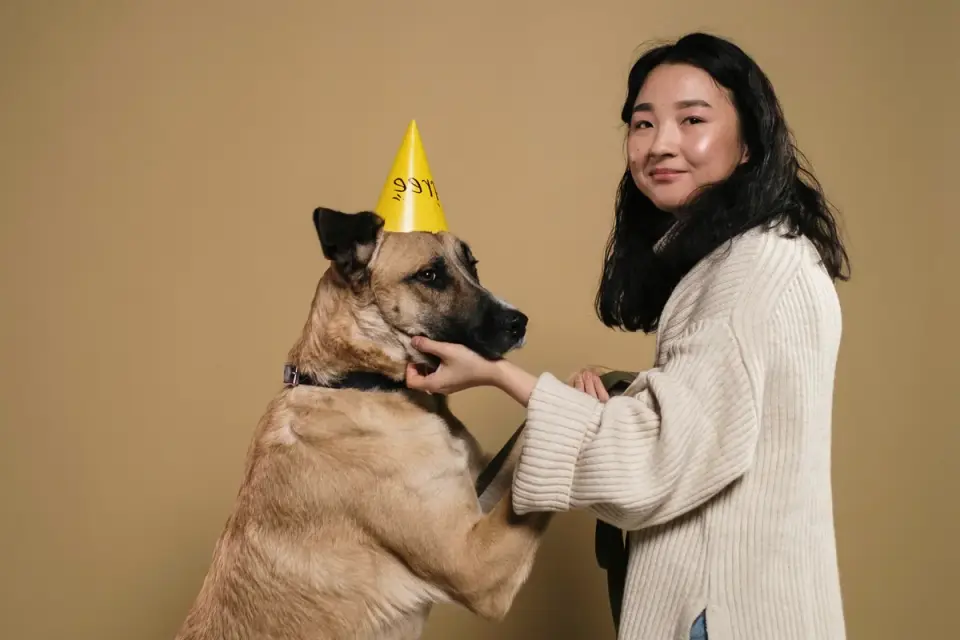
Reading the body before you read the behavior
Fear rarely announces itself as dramatically as a bolt for the door. Before that, most dogs show a lowered head, a tucked tail, whale eye (the whites showing at the corner), lip licking with no food around, and weight shifted backward onto the haunches. Some freeze instead of flee — this is not calm, it’s a dog deciding fleeing isn’t an option. Barking or growling at the object is also fear, not necessarily aggression; distance-increasing behavior is the goal either way. If you’re unsure whether what you’re seeing is fear-based reactivity or something closer to territorial or resource-guarding behavior, the distinction matters for the plan — see Barrier Frustration vs Aggression: What’s the Difference? for how to tell them apart.
Recognizing the early signals matters because the entire treatment approach depends on staying under threshold — working at a distance or intensity where the dog notices the object but doesn’t fully panic. Push past that line and you’re not desensitizing, you’re rehearsing the fear.
What actually helps: desensitization and counterconditioning, done slowly
The single most defensible, evidence-backed approach for object fears in dogs is systematic desensitization paired with counterconditioning — introducing the trigger at a low enough intensity that the dog stays calm, and pairing that exposure with something the dog genuinely values, usually food. For an umbrella, that means starting with it closed and stationary, ten feet away, rewarded generously for calm attention. Only once the dog is loose and eating normally at that distance do you shrink the gap or introduce motion. Opening the umbrella comes last, often days or weeks later, not in the first session.
For hats, the same principle applies at a smaller scale: let the dog watch you put a hat on and take it off repeatedly at a distance where there’s no reaction, rewarding calm observation, before you ever approach wearing it. I tell owners to expect this to take longer than they want it to — most meaningful shifts in a genuinely fearful dog happen over two to six weeks of short, daily sessions, not a single afternoon. Rushing it to “get it over with” is the most common mistake I see, and it usually sets a dog back further than doing nothing at all.
What I don’t recommend is flooding — forcing exposure and waiting for the dog to “get used to it.” Some dogs do go quiet under flooding, but that quiet is often learned helplessness, not resolved fear, and it can make the next novel object worse, not better. I’d rather a client move slower and actually get there.
Where diet, exercise, and daily structure fit into the picture
Before any calming aid, I look at the basics: is this dog getting enough physical exercise to actually settle afterward, is she sleeping enough, and is her daily routine predictable enough that a startling event doesn’t land on an already-frayed nervous system? A dog who’s under-exercised and running on interrupted sleep reacts to everything more sharply, umbrellas included. This is true whether the underlying issue is fear of objects, general anxiety, or something owners initially mistake for one problem when it’s actually another — the same logic applies when sorting out Boredom vs Separation Anxiety: How to Tell the Difference or figuring out whether repetitive chewing is boredom or anxiety.
A predictable daily structure — consistent walk times, consistent feeding, a settled place to retreat to — gives an anxious dog’s baseline arousal somewhere lower to sit, which makes any single scary event easier to recover from. This is the unglamorous part of the plan, and it’s also the part that moves the needle the most.
Where structure/function calming support can genuinely help, and where it can’t
For dogs whose baseline anxiety is high enough that even slow desensitization work is a struggle, some owners look at calming ingredients as a bridge, not a fix. The evidence here is real but modest, and it’s worth being honest about that instead of overselling it. Biomedicines: Chamomile has a long history in traditional herbal use for relaxation, though for most species — dogs included — the supporting evidence is derived mainly from preclinical studies or traditional use rather than large controlled trials. Cureus: KSM-66 Ashwagandha, a specific studied extract form, fares better in the human literature: a systematic review of multiple randomized controlled trials concluded it has a moderate positive impact on stress reduction and cognitive performance. Molecular Psychiatry: L-theanine also has calming research behind it, though the strongest human data — an effect size of 0.54 at 400 mg per day for eight weeks — comes from a study on psychotic anxiety specifically, which is a narrower population than “everyday dog on a walk.”
None of these ingredients will make a fear response disappear on their own, and I’d never present one as a substitute for the desensitization work above. What they can do, for the right dog, is take the edge off baseline reactivity enough that training sessions go better. That’s a supporting role, not the plan itself.
A short case that changed how I frame this for owners
A twenty-two-pound goldendoodle named Ranger came in after his owner described him “losing it” every time she opened a beach umbrella in the backyard — spinning, barking, trying to climb into her lap mid-walk. We started at fifteen feet with the umbrella closed on the ground, feeding for calm glances toward it, nothing more. Over about four weeks, in short five-minute sessions most days, we worked down to five feet, then to it being propped open but stationary, then finally to her opening it slowly while he watched from a mat with a chew. By week five he could lie on that mat while she opened and closed it normally. It wasn’t fast, and there were two sessions where he regressed after a loud thunderstorm the same week — which is normal, not a sign the plan failed. What changed his owner’s approach more than anything was seeing that patience, not persistence through panic, was what actually worked.
The bottom line
Fear of umbrellas, hats, and other novel objects is a normal, treatable response to a genuine sensory jump, not a character flaw or a sign your dog is broken. Slow, dog-paced desensitization paired with rewards is the intervention with the actual evidence behind it; a predictable daily routine and adequate exercise make that work land better; and structure/function ingredients like chamomile, ashwagandha, and L-theanine may help take the edge off for some dogs but are a support, not a substitute. If a previously confident dog suddenly develops new fears, especially as a senior, loop in your veterinarian — sensory changes and pain can masquerade as “just” a behavior problem.
Frequently asked questions
Is it normal for a dog to suddenly become afraid of something he's seen before, like an umbrella or a hat?
Yes. A single startling pairing — an umbrella snapping open unexpectedly, a hat worn in an unusual context — can create a new fear even in a dog who was previously unbothered by the object. Sudden-onset fear in a senior dog is also worth a veterinary check, since vision or hearing changes can make familiar objects seem newly threatening.
How long does it usually take to help a dog get over fear of an object?
Most dogs show meaningful improvement over two to six weeks of short, daily desensitization sessions, though timelines vary with the individual dog and how consistently the sessions happen. Rushing the process tends to set dogs back further than working slowly.
Should I comfort my dog when she's scared of an umbrella or hat, or will that reinforce the fear?
Comforting a genuinely frightened dog does not reinforce fear — fear is an emotional state, not a behavior you can reward into existence. Calm reassurance paired with increasing distance from the trigger is appropriate; what to avoid is forcing continued exposure while the dog is already over threshold.