Play Bow or Aggression? Reading Dog-to-Dog Signals
A veterinarian's field guide to telling real dog play from a real fight, with the body-language checkpoints that matter most and what to do when you're not sure.
I tell clients to stop counting growls and start counting how often the dogs swap who's on top.
On this page
Two dogs collide at full speed, one goes down, teeth flash, and someone yells “he’s fine!” from across the yard. Are they? That question is the reason this topic exists, and it’s the one I get asked more than almost anything else in my exam room.
I’ve watched hundreds of dogs meet each other for the first time, and the honest answer is that noise is the least reliable signal in the whole interaction. Growling, snapping jaws, even a yelp — none of it tells you as much as what the dogs do in the half-second after. Real play has a rhythm. Real conflict doesn’t.
The signal that matters most: does it stop and restart?
Here’s the test I give owners, and it’s the one I trust over every other rule of thumb: watch for a pause, then watch what happens next. Play has natural intermissions. A dog who’s pinned play-bows again, shakes off, and dives back in. A dog on the losing end of a real fight tries to leave, and the other dog follows.
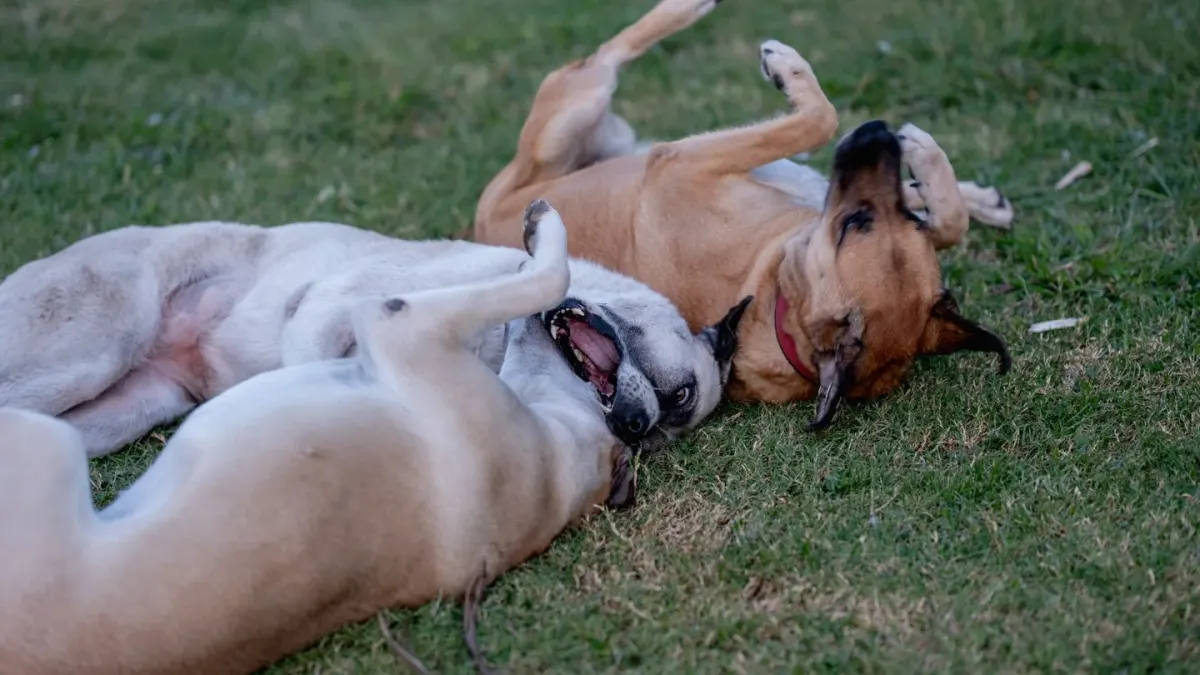
That pause-and-restart pattern is doing more work than any single posture. A play bow — chest to the ground, rump in the air, tail loose and wagging — is the clearest invitation dogs give each other, but it’s not proof of anything by itself. I’ve seen dogs offer a bow and then escalate past what the other dog wanted. What tells you it’s still play is that the interaction keeps resetting on its own, without one dog forcing it.
Play looks rough. That’s normal. Here’s what shouldn’t be there
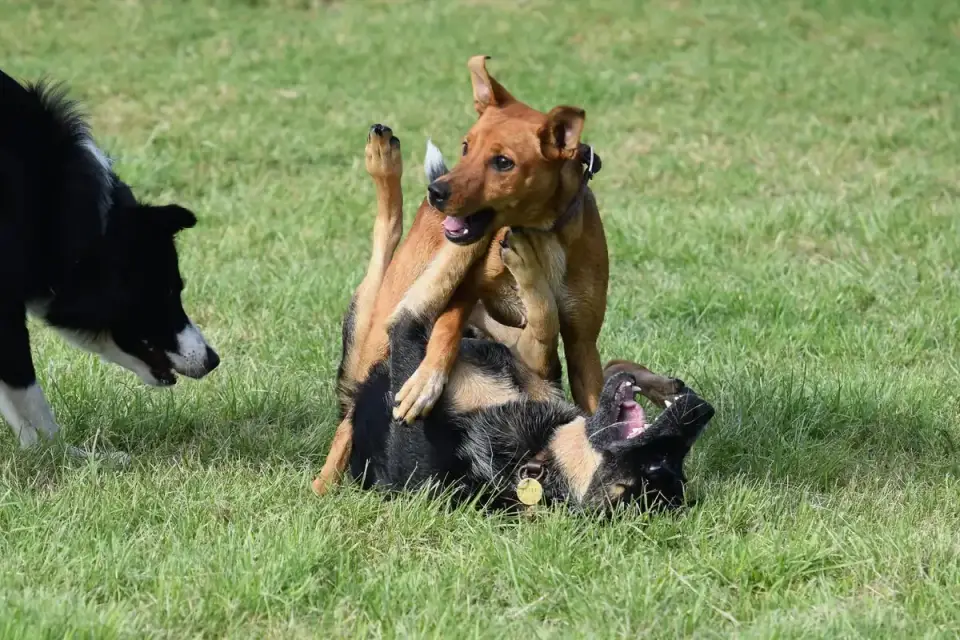
Owners often bring me video, worried, of dogs that look like they’re trying to hurt each other. Most of the time they’re not. Play fighting includes hard body slams, open-mouth wrestling, growling, and even the occasional yelp when a tooth lands wrong. None of that alone tells you it’s gone bad.
What I’m actually watching for: stiff, frozen posture instead of loose, bouncy movement. A tail held high and rigid rather than swinging. Ears pinned flat and staying that way. Lip curled with the whole face tense, not just a quick warning snap. Fur raised the length of the spine. And the biggest one — a dog that is trying to get away and can’t.
Role reversal is the other checkpoint I lean on. In genuine play, the dog who was chasing becomes the one being chased, over and over, sometimes within the same minute. That back-and-forth almost never happens in a real conflict, because a dog defending itself isn’t interested in trading places with its attacker.
A quick side-by-side
| Signal | Usually play | Usually a real fight |
|---|---|---|
| Body | Loose, bouncy, exaggerated movements | Stiff, frozen, or hunched |
| Pauses | Interaction stops and restarts on its own | One dog tries to disengage and can’t |
| Roles | Chaser and chased switch repeatedly | Roles stay fixed; one dog is always on the defensive |
| Mouth | Open, relaxed, “play face” | Closed tight or lips retracted in a hard stare |
| Sound | Growls and barks mixed with silence | Sustained, high-pitched, or panicked vocalizing |
| Space | Both dogs return voluntarily | One dog repeatedly tries to put distance between them |
A case that still shapes how I explain this
A client brought in her twelve-week-old Bernedoodle puppy, about eighteen pounds, after a meetup at a local dog park went sideways in her mind. She’d watched her puppy get flattened by an adult Lab mix, heard a yelp, and pulled him out immediately, convinced he’d been attacked. When we reviewed her phone video together, frame by frame, in my exam room that afternoon, the picture looked different. The Lab had backed off within a second of the yelp and stood still, tail loose, waiting. The puppy shook himself off, did a full play bow, and ran back in. They’d swapped chaser and chased four times in ninety seconds before she’d stopped the clip. What she’d read as an attack was a startle response followed by an active choice to keep playing — from both dogs. I still use that video, with her permission, when I explain the pause test to new clients.
When play tips into something that needs a break
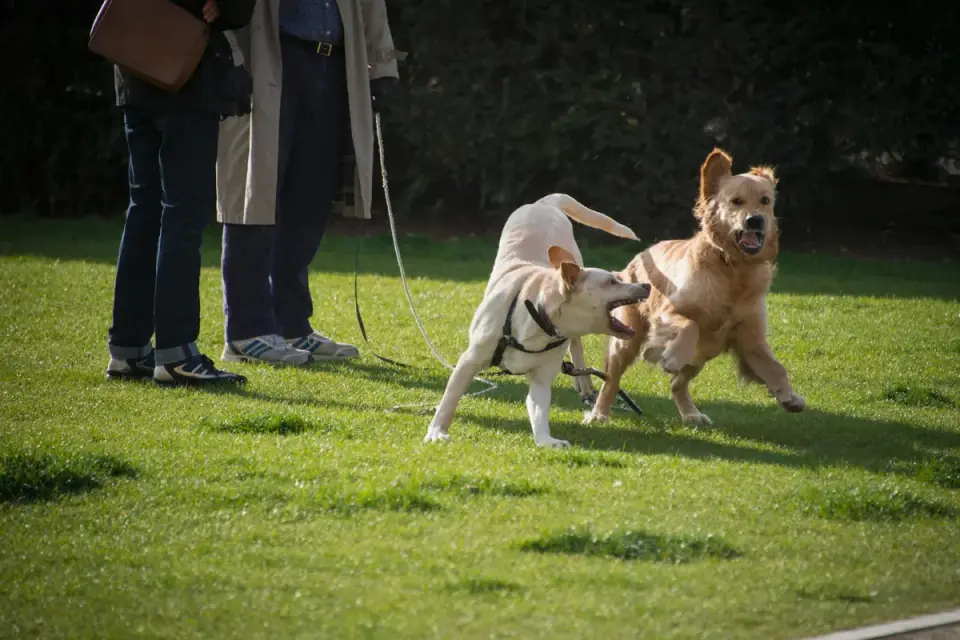
Some dogs, especially adolescents and dogs with limited socialization history, don’t reliably self-regulate. They’ll play too hard, miss the other dog’s signals to slow down, or get so aroused that the interaction stops looking mutual. This is where owner intervention matters more than reading a chart. If one dog is repeatedly trying to disengage — moving behind furniture, a person, or a tree, or freezing and turning its head away — and the other keeps pursuing, that’s your cue to call a break, not wait and see.
I also see a subset of dogs who genuinely enjoy other dogs but arrive at every meetup keyed up before a single interaction happens — pacing at the door, whining in the car, unable to settle even in calm settings. For those dogs, addressing the underlying arousal and stress before the greeting often does more than any amount of correcting mid-play. A systematic review in Cureus found that ashwagandha has a moderate positive impact on stress reduction, and a broader review published in Biomedicines notes that most of the calming evidence for chamomile in animals is still preclinical or based on traditional use rather than large trials — worth knowing before you lean on any supplement as your main plan. Diet, sleep, and a slower introduction routine remain the foundation; a review in Molecular Psychiatry found L-theanine’s calming effect held up in human studies at 400 mg/day for 8 weeks, but that dosing data doesn’t transfer directly to dogs, and I don’t extrapolate it that way for patients.
What I actually tell owners at the visit
By the time a client is asking me this question, they’ve usually already sensed something was off — that’s what brought them in. I don’t hand them a checklist and send them home. I walk through the pause test first, because it’s the single habit that changes how people watch their dogs. Then we talk about body carriage: loose versus stiff, bouncy versus frozen. Only after that do we get into vocalizing, because sound is what triggers alarm the fastest and tells you the least.
For a young or newly adopted dog still building social skills, I’ll often connect this conversation back to the basics of daily structure — exercise, consistent routine, and calm handling — because a dog who’s well-exercised and not overtired tends to self-regulate better in play than one who’s wound up and under-exercised. Our guide to getting started with whole-dog wellness covers those fundamentals if you’re building that routine from scratch.
If you take one thing from an exam-room conversation with me, let it be this: don’t referee based on noise, and don’t assume rough automatically means dangerous. Watch whether the dogs keep choosing each other. That’s the signal that holds up, over and over, in a busy dog park and in a living room with two housemates who’ve known each other for years.
Frequently asked questions
How can I tell if my dog is playing or fighting with another dog?
Watch for pauses that both dogs voluntarily end, loose and bouncy body movement, and roles — chaser and chased — that switch back and forth. Real conflict tends to stay one-sided and doesn't self-interrupt the way play does.
Is growling always a bad sign between dogs?
No. Growling is common in normal play and isn't a reliable warning sign on its own. Body posture — stiff versus loose, frozen versus bouncy — tells you far more than sound does.
Should I let dogs "work it out" if it looks rough?
Only if both dogs are voluntarily returning to the interaction and one isn't repeatedly trying to disengage. If a dog is trying to leave and can't, step in and separate them.