Surviving Puppy Crate Crying at Night: What Actually Helps
A vet's practical, evidence-based guide to nighttime crate crying in puppies — what's normal, what's a red flag, and the steps that actually settle a pup down.
Nighttime crate crying is a communication problem first, a training problem second, and rarely a defiance problem at all.

It was a 9-week-old Cavalier mix named Biscuit, and his owners had already tried three different crates by the time they called me. He’d go in fine at 9 p.m., sleep for maybe ninety minutes, and then scream — not whine, scream — until someone came. They’d tried ignoring it for twenty minutes at a stretch, per advice from a well-meaning neighbor, and Biscuit just escalated. By week two, nobody in that house had slept more than four hours straight, and the leading theory on the kitchen counter was that he was “just stubborn.” He wasn’t. He was seven weeks removed from his littermates, his bladder couldn’t yet hold through a full night, and the crate was in a guest room down the hall from where his people slept. Once we moved the crate into the bedroom and added one structured potty break, the screaming dropped to occasional whimpering within four nights.
That pattern — new owners assuming defiance when the real problem is unmet physical or emotional need — is the single most common misread I see in early puppyhood. A puppy crying in a crate at night is almost never plotting an escape from confinement in the abstract. He’s usually cold, needs to urinate, or is grieving the loss of constant physical contact with littermates and, before that, his mother. Puppies are a highly social, denning species, and total isolation at an age when they’d still be piled on top of siblings is a legitimate stressor, not a character flaw.
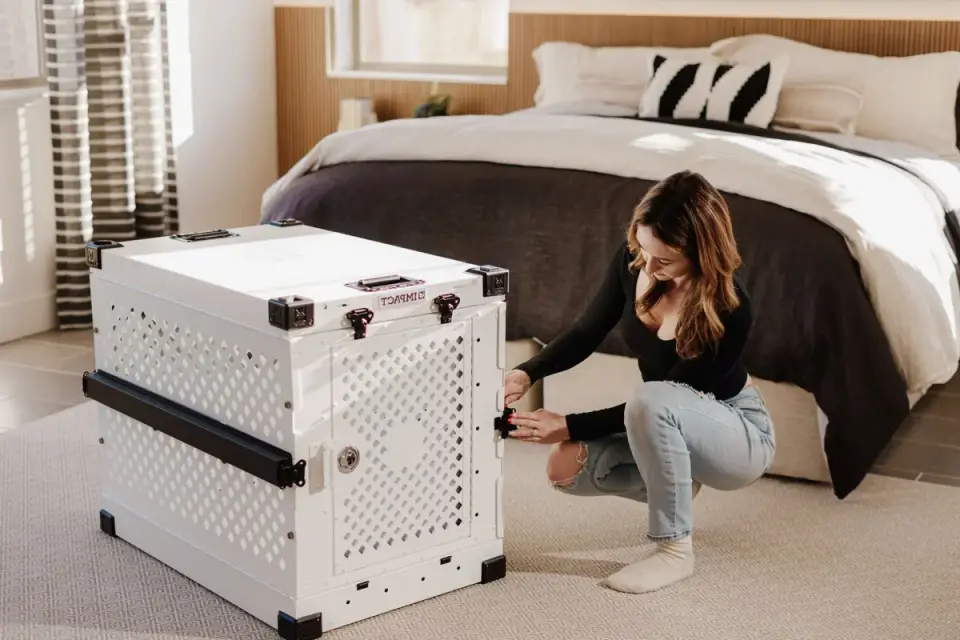
Start with the physical checklist before you touch the training plan. Most crying resolves faster than owners expect once the basics are covered: a last potty trip right before bed, water removed roughly 90 minutes before lights-out (not withheld all evening), a crate sized so the puppy can stand and turn around but not so large he can soil one end and sleep in the other, and a location within earshot — ideally within sight — of a person for at least the first several weeks. A puppy under about four months old physiologically cannot hold urine for eight hours, so a 2 a.m. or 3 a.m. bathroom trip is often not a training failure; it’s biology, and treating it as misbehavior sets the whole relationship off on the wrong foot.
Location matters more than most first-time owners expect. A crate isolated in a laundry room or garage strips away the ambient reassurance of breathing, movement, and scent that a puppy has relied on since birth. Moving the crate into the bedroom, even temporarily, is one of the highest-yield changes I recommend, and it costs nothing.
Once the physical needs are covered and the crying continues, the next layer is emotional regulation — and this is where owners often reach for a calming aid before they’ve actually finished the behavioral groundwork, which I’d argue is backwards. Short, low-stress daytime crate sessions paired with a stuffed food toy build the association that the crate predicts good things, not abandonment. A puppy who’s never spent calm daytime minutes in the crate has no reference point for why it’s supposed to be safe at 1 a.m. Consistency in the wind-down routine — same order of events every night, delivered in a calm, unhurried tone — gives a young nervous system something predictable to hold onto, and predictability is genuinely calming for a developing brain.
Where does a calming supplement fit, if at all? Cautiously, and only as an adjunct, never a substitute for the checklist above. The evidence base for herbal and amino-acid calming ingredients in dogs specifically is thinner than marketing copy implies, and I say that as someone who reaches for these tools regularly in practice. For chamomile, much of what we know still comes from outside the target species — as one review notes, “for the remaining species, evidence is derived mainly from preclinical studies or traditional use,” per a review published in Biomedicines. That’s not a reason to dismiss chamomile, but it is a reason to treat it as a mild, traditional-use support rather than a fix for a genuinely distressed puppy.
Ashwagandha has a somewhat firmer human evidence base to draw analogies from. A systematic review in Cureus “analyzed multiple RCTs and concluded that ashwagandha has a moderate positive impact on stress reduction and cognitive performance” — again, this is human data, but it’s the kind of signal that makes the ingredient worth discussing with your veterinarian if daytime anxiety is part of the picture, not just nighttime crate protest. L-theanine has more mixed results across the literature; a review in Molecular Psychiatry found benefit in most anxiety measures “except for one study on psychotic anxiety (SMD = 0.54; 400 mg/day for 8 weeks),” a dose studied in adult humans and not something to extrapolate directly onto a ten-pound puppy without professional guidance.
I think about a Lab puppy I worked with last spring, ten weeks old, about 14 pounds, whose owner was a nurse coming off overnight shifts and desperate for any edge. We didn’t reach for a supplement first. We fixed crate placement, added a 15-minute wind-down walk before bed, and pushed the last meal earlier so a full bladder wasn’t waking him at 3 a.m. Crying dropped from nightly to maybe twice a week within ten days, no supplement involved. I’m not against calming aids as one small piece of a broader plan — I’ve used them — but I’ve watched too many owners buy a bottle of something before they’ve moved the crate six feet, and the crate move is almost always the bigger lever.
A few signs do warrant a same-week vet visit rather than more patience: crying accompanied by straining to urinate, vomiting, diarrhea, or a puppy who seems distressed around the clock rather than specifically at bedtime. Separation-related distress that persists well past the eight- to twelve-week settling window, or that shows up alongside destructive chewing at the crate door and self-injury attempts, is also worth a conversation with your vet or a certified trainer rather than something to wait out. For a broader framework on where nutrition, exercise, and behavior fit into a young dog’s overall care, see our Whole-Dog Wellness starting guide.

So where do I land, expectation first, the way I’d tell it to a client sitting across from me? Fix the physical setup and the daytime association before you spend a dollar on anything calming. The counterargument I hear most is that owners are exhausted now and want the fastest fix available tonight — and I understand that completely, four nights of screaming will wear anyone down. But a supplement layered onto a crate that’s in the wrong room, at the wrong size, with no daytime positive association, tends to underperform and leaves owners thinking the ingredient failed when the setup never had a fair chance. Most puppies who cry hard at night are asking a specific, answerable question: am I safe, and is someone coming. Answer that consistently for a week or two, and the crying usually answers itself. What would change if you assumed your puppy’s crying was information rather than a battle to win?
Frequently asked questions
Is it okay to let a puppy cry it out in the crate?
Not usually at this age. A young puppy's crying is more often a physical or emotional need than manipulation, so a brief, calm check tends to work better than extended ignoring, especially in the first few weeks home.
How long does crate crying typically last?
Many puppies settle within one to two weeks once the crate location, size, and bedtime routine are adjusted; crying that persists unchanged well beyond that, or that includes physical symptoms, is worth a vet visit.
Should I move the crate into my bedroom?
For most young puppies, yes, at least temporarily. Proximity to a person reduces the isolation that's driving a lot of nighttime distress, and it can be moved to another room gradually as the puppy matures.