Play Growl or Warning Growl? How to Tell the Difference
A vet's field guide to reading a dog's growl — the body language, context, and timing that separate rowdy play from a real warning.
Tell a play growl from a warning by watching the whole dog, not the sound — the body tells you what the growl alone can't.
On this page
A client brought in a two-year-old pit bull mix named Biscuit last spring because her housemate, a much older beagle, had started growling every time Biscuit flopped down near his food bowl or his bed on the living room floor. The owner was rattled — she’d always heard growling meant a dog was “about to bite,” and she wanted the beagle checked for something medical. Nothing was wrong with him. What she was hearing was a warning growl, low and still, aimed at protecting a resource, and it was completely different from the growling Biscuit made during their tug-of-war games in the backyard twenty minutes later. Same sound to an untrained ear. Two very different messages.
Owners ask me this more than almost anything else in behavior consults: is that growl play, or is it real? The honest answer is that the growl itself is rarely the most useful piece of information. The body around it is.
Start with the whole dog, not the noise
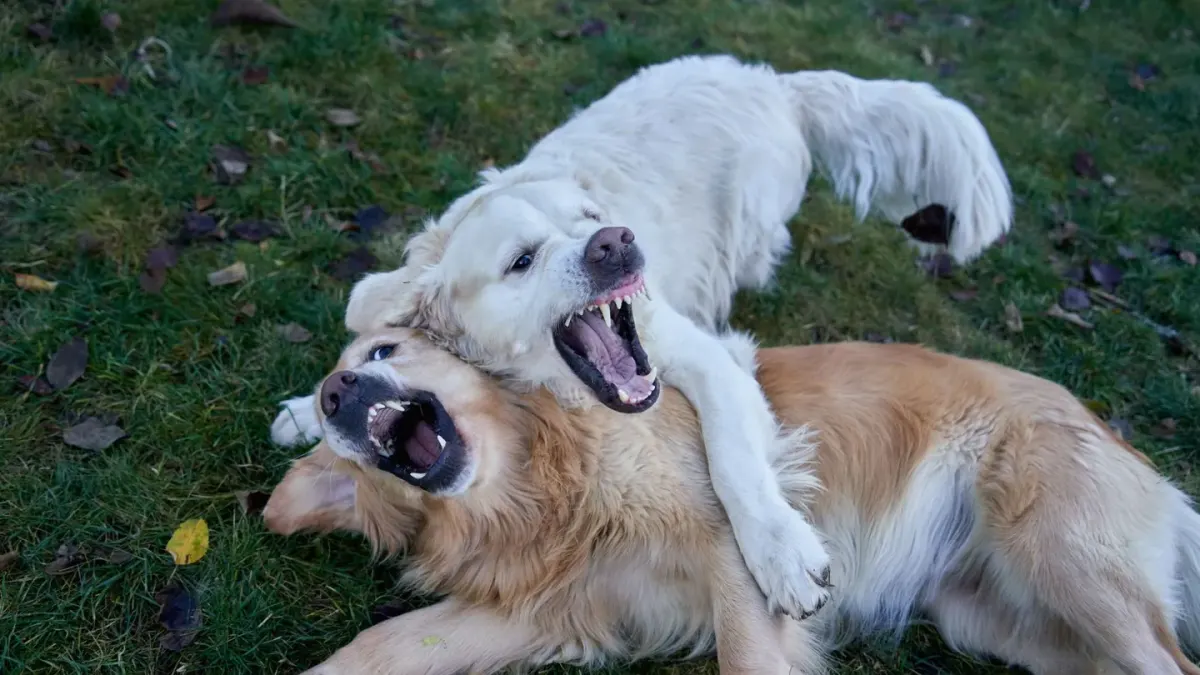
I tell every client the same thing before we even talk about pitch or volume: mute the sound in your head and watch the shape of the dog. A growl paired with a loose, wiggly body, a play bow, bouncing movement, and brief pauses to “reset” is almost always play. A growl paired with a stiff, still body, a hard stare, weight shifted forward or frozen, and no breaks in the tension is a warning. The growl is just the soundtrack. The body is the script.
Play growls happen inside motion. Watch for a play bow — front legs down, rear end up — right before or during the growl. Watch for the dog offering a “role reversal,” where the chaser becomes the chased. Watch for a loose, open mouth, ears that flick rather than pin, and a tail that’s moving, even if it’s not a full wag. Dogs playing also self-interrupt constantly: they growl, break off, sniff the ground, come back. That pause-and-return rhythm is one of the most reliable tells I know, because a genuinely aroused or defensive dog rarely takes it.
Warning growls happen inside stillness. The body gets quiet before the sound does. Weight goes forward onto the front feet, or the dog goes rigid and low. The mouth tends to close or curl rather than stay open and loose. Eye contact is fixed, not glancing. And there’s usually a very specific trigger you can name — a hand near a bowl, a body too close on the couch, a touch near a sore hip — rather than the diffuse, bouncing energy of a wrestling match.
What I actually rule out first
Before I tell an owner “that’s just play,” I want three questions answered, because guessing wrong here has real consequences.
First: is there a resource involved — food, a toy, a bed, a person, a doorway? Growling that shows up consistently around one specific object or space is doing resource-guarding work, even if it looks mild. Second: has the growling changed recently, especially in an older dog or one with a new limp, stiffness, or reluctance to be touched in one spot? Pain-driven growling can look almost identical to a warning growl at rest, and it deserves a veterinary exam before a training plan. Third: does the growl happen only with one specific dog or person, or does it show up broadly? A pattern tied to one relationship usually points to something concrete — space, resources, history — rather than generalized fear.
I ask these because growling is information, not a behavior to punish out of a dog. A dog that growls and gets scolded for it doesn’t stop feeling threatened; it just stops warning you before it acts. That’s the outcome nobody wants.
When play tips into something real
Play growling can escalate, and it’s worth knowing what that shift looks like instead of assuming every growl during a wrestling match is fine because it started as a game. Watch for the pauses disappearing — a dog that stops self-interrupting and stops offering breaks is no longer playing by the same rules. Watch for one dog’s body going stiff while the other keeps bouncing; play requires both dogs reading each other, and a mismatch is where trouble starts. Watch for a growl that gets lower and steadier rather than staying loud and erratic. If you see any of that, a short verbal interrupt and a physical break — calling both dogs away, leashes if needed — is the right move, not a punishment, just a reset.
I worked with a family last year whose two dogs, a young Labrador and an older Australian shepherd, played rough almost every evening in the backyard. It had gone on for months without incident. Then over about two weeks, the owner noticed the Lab starting to pin the shepherd rather than trading positions, and the shepherd’s growl had shifted from the loud, bouncy sound of their usual games to something lower that didn’t stop when the Lab backed off. She called before it turned into a fight, we separated their play sessions and rebuilt them in short, supervised bursts with breaks every thirty seconds, and within about three weeks they were back to trading roles the way they used to. What told her something had changed wasn’t the volume of the growl. It was that the pauses had stopped.
Where stress and arousal management fit
For dogs whose warning growling is tied less to a single resource and more to general tension — over-arousal during play that reliably tips into stiffness, or a dog who growls defensively any time the household gets loud or chaotic — the first and most important lever is still management: shorter play sessions, more predictable routines, and separating dogs before arousal peaks rather than after. That’s the un-glamorous, do-this-today work, and it matters more than anything you’d add to a bowl.
Where the evidence is genuinely useful, though, is as an adjunct once the behavioral groundwork is in place. Chamomile has a long history in traditional herbal care for supporting relaxation, and a recent review in Biomedicines notes that for most species, the evidence base is still built mainly on preclinical studies and traditional use rather than large clinical trials in dogs — worth knowing before expecting too much from it. L-theanine, an amino acid found in tea, has been studied for calming properties in humans; a review in Molecular Psychiatry found a meaningful effect in one anxiety study using 400 mg/day over eight weeks, though that dose and population don’t automatically translate to dogs. I mention these because owners ask, and because “may help support” is an honest way to describe where this category currently stands — not a replacement for reading the dog correctly in the moment.
What I tell owners at the appointment
By the time Biscuit’s family and I finished going through it, the plan was simple: manage the food and bed spaces so the beagle didn’t have to guard them, give both dogs separate resting spots, and stop treating the beagle’s growl as bad behavior. He was communicating exactly the way a dog is supposed to. If your household is working on tension between dogs, our guide on how long a dog’s walk should be is a good place to look at whether under-exercised dogs are carrying more pent-up arousal into play than they should, and our pavement-test guide to heat and walk timing is useful if hot-weather walks have been getting cut short and energy is backing up at home. For anyone starting from scratch on the basics, Whole-Dog Wellness: A Practical Starting Guide covers the daily structure that makes reading a dog’s signals easier in the first place.
Play growls and warning growls sound more alike than they behave. Read the body, name the trigger if there is one, and treat the growl as useful information rather than a problem to silence.
Frequently asked questions
Can a growl be both play and a warning at the same time?
Yes. Play can escalate mid-session, especially with over-arousal — that's why watching for stiffening bodies and disappearing pauses matters more than judging the first growl you hear.
Should I ever punish a dog for growling?
No. Punishing a growl tends to suppress the warning, not the underlying discomfort, which can leave a dog more likely to skip straight to a bite next time.
My dog only growls at one family member. What does that mean?
It usually points to something specific — history, handling, or a resource tied to that person — rather than a generalized behavior problem, and it's worth working through with a trainer or your vet rather than ignoring it.
Sources
- Chamomile in Anxiety and Stress: Preclinical and Traditional Evidence — Biomedicines
- L-Theanine and Anxiety and Stress Outcomes — Molecular Psychiatry