How Long Should a Dog's Walk Be?
A veterinary nutritionist and sports-medicine vet explains why walk length isn't a fixed number of minutes, and how to size a walk to your dog's joints, age, and conditioning.
How long a dog's walk should be depends on age, joint health, and conditioning more than any single stopwatch number.

On this page
A leash goes on, a door opens, and most owners just start walking until the dog seems done, or until the clock says the walk “counts.” I get why. It’s the question I hear most often in exam rooms that double as mobility consults: not “should I walk my dog,” but “for how long, exactly?” The honest answer is that there isn’t one number. There’s a range, and where your dog falls in it depends on joint maturity, conditioning, and what’s actually happening inside the joint capsule during that walk.
In my practice, the dogs who reveal the most about walk length aren’t the young, healthy retrievers bounding through a 45-minute loop. They’re the ones in transition — a 7-year-old Labrador named Otis who I saw last winter, 82 pounds, whose owner mentioned almost in passing that he’d started sitting down twice on their usual half-mile route around the block. He wasn’t limping. He wasn’t refusing to go. He just paused, once near the mailbox and once by the corner oak, then kept going like nothing happened. That’s the kind of detail owners tend to dismiss because the dog “still wants to go.” But a healthy joint doesn’t ask for a break at the same two spots on the same walk, week after week. We shortened his walks to two 15-minute outings instead of one 30-minute loop, and within about three weeks the pauses stopped showing up on that same stretch of sidewalk.
Why duration is really a joint-loading question
Walking is low-impact compared to running or jumping, but it’s still repetitive loading on cartilage, synovium, and the soft tissue around a joint. Cartilage doesn’t have its own blood supply — it depends on the mechanical cycling of joint fluid to move nutrients in and waste out. That’s part of why moderate, regular movement is good for joints in general, and also why a joint that’s already inflamed or degrading doesn’t tolerate the same total minutes as a healthy one. Ingredients like chondroitin, which a peer-reviewed study in Frontiers in Veterinary Science found “supports healthy synovial fluid homeostasis,” are studied precisely because that fluid environment is what determines whether repeated loading helps a joint or wears on it. Glucosamine has a similar story: a review in the Journal of Veterinary Medical Science describes glucosamine HCl’s ability to help “prevent experimentally induced cartilage degradation in vitro” — evidence generated in a lab, not a guarantee of outcome in a walking dog, but a real signal about the mechanism a stiff or aging joint is contending with.
Puppies: the growth plate problem, not a stopwatch problem
Puppy walk length isn’t really about stamina. It’s about growth plates — the areas of cartilage near the ends of long bones where new bone forms until the dog reaches skeletal maturity. Those plates are softer and more vulnerable to injury than mature bone. According to How Exercise Can Damage Puppy Growth Plates: VCA Animal Hospitals, small-breed dogs’ growth plates close at “a little over 6 months old,” while giant-breed dogs’ plates may not close until “closer to 1½ years.” The same source recommends against long jogs, hikes, or competitive jumping before maturity, and its practical advice is to let a puppy self-regulate rather than chase a fixed daily minute target. In real terms, that means multiple short, easy walks rather than one long outing, especially for large and giant breeds still months from a closed growth plate.
Adult dogs: build the number from energy level and body condition, not a chart
Once a dog is skeletally mature, walk length becomes a conditioning question. A lean, well-muscled adult in a working or sporting breed can handle considerably more daily walking than a heavier-bodied or brachycephalic dog of the same age. Rather than memorizing a breed-by-breed minute chart, I ask owners to watch three things after a walk: does the dog recover its normal breathing within a few minutes of stopping, is the gait even on the way home as it was at the start, and is the dog seeking the couch immediately or still interested in normal activity an hour later. If all three look normal, the walk length is probably appropriate. If any one of them is off, the walk was too long for that day, not necessarily too long in general — heat, humidity, and surface all shift the real answer.
Here’s the short version for a fit, mature adult dog with no diagnosed joint disease: most tolerate 30 to 60 minutes of daily walking well, split into two sessions if the household schedule allows it. Splitting matters less for a young, healthy dog and more as a dog ages, because joints that have started to change respond better to shorter, more frequent bouts than to one long session that pushes past the point of easy movement.
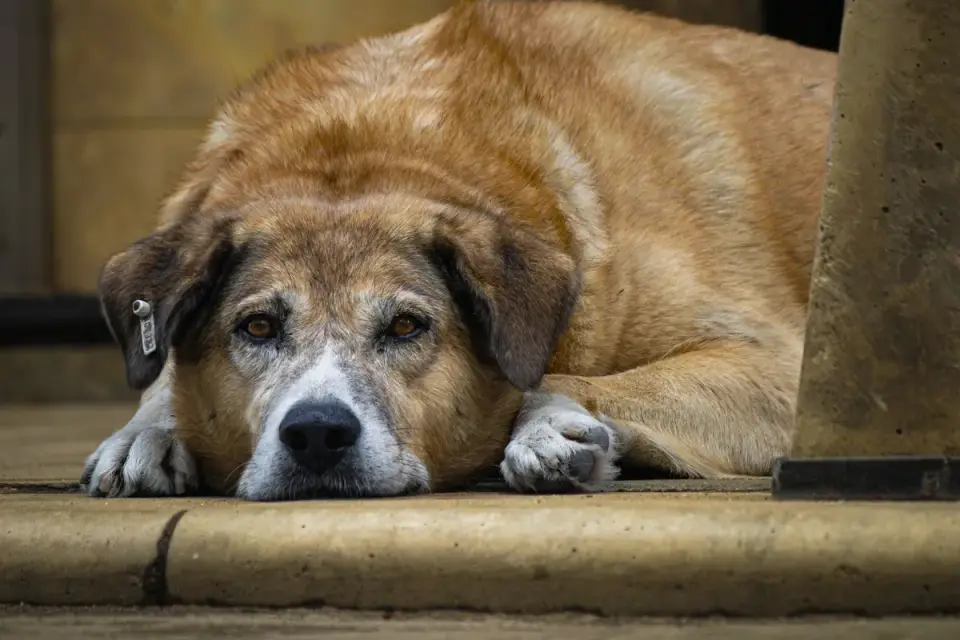
Senior dogs and diagnosed osteoarthritis: shorter, more frequent, not “less”
This is where I push back hardest against the instinct to just cut a senior dog’s walks down and call it done. Total activity still matters for a dog with osteoarthritis — muscle that supports an arthritic joint atrophies quickly with inactivity, and that loss of support tends to make the joint feel worse, not better. Exercising Dogs with Osteoarthritis: VCA Animal Hospitals recommends starting arthritic dogs at “10 minutes of walking, three times a day,” increasing that duration gradually on a weekly basis if the dog tolerates it without added soreness. The logic tracks with what cartilage needs functionally: frequent, moderate cycling of joint fluid, without the sustained loading of one long walk that lets stiffness set in during the following hours of rest.
I think about a 10-year-old mixed-breed shepherd type I saw a few months back, stiff getting up in the morning but still wanting to go on the family’s usual 40-minute evening walk. Her owner was weighing whether to just stop walking her altogether out of worry, versus pushing through the stiffness because “she seems happy once she’s moving.” Neither extreme was right. We moved her to three short walks spread across the day, added a joint-support ingredient her owner had researched, and watched her morning stiffness ease over about a month, judged mainly by how long it took her to settle into a normal gait after standing up. Green-lipped mussel is one ingredient with legitimate mechanistic support here — research in Nutrients found that mussel extracts “alleviated paw swelling in rats and reduced serum levels of rheumatoid factor (RF), anti-cyclic citrullinated peptide (anti-CCP) antibody, and pro-inflammatory cytokines such as TNF-α and IL-17” in an animal inflammation model — evidence worth taking seriously, though it’s not a substitute for adjusting the walk itself. Vigorous chasing games, quick pivots, or off-leash sprinting are worth avoiding for these dogs; the loading pattern is the opposite of what a fragile joint tolerates well, involving abrupt stops and twisting rather than the steady, even cycling a walk provides.
Where this leaves the actual number
If you want a starting point rather than a formula: a healthy adult dog usually does well with 30 to 60 minutes of daily walking split across the day; a puppy should be moving in short, frequent, low-impact bouts rather than long outings until growth plates close; and a senior or arthritic dog often does best on several 10 to 15 minute walks rather than one long one. None of those numbers are load-bearing on their own — they’re a reasonable range to adjust from once you’re watching how your own dog’s gait, breathing, and recovery respond. That’s a more useful habit than any single fixed minute count, and it’s one you can start building tonight, on whatever walk comes next. For a broader framework on building daily routines around a dog’s whole-body health, our Whole-Dog Wellness: A Practical Starting Guide is a good next stop.
Frequently asked questions
Is there a single correct number of minutes for a dog's daily walk?
No. A reasonable starting range is 30–60 minutes for a healthy adult dog, split into two sessions, but age, breed, weight, and joint health all shift that number. Watch recovery — breathing, gait, and interest in activity afterward — rather than chasing a fixed total.
What is the "5-minute rule" for puppies?
It's a commonly cited guideline suggesting five minutes of structured walking per month of age, twice daily, though not every veterinary source formally endorses it. The underlying principle — short, low-impact activity until growth plates close — is well supported regardless of the exact formula used.
My senior dog seems stiff after long walks. Should I stop walking her?
Usually not entirely. Dogs with osteoarthritis generally do better with several short walks spread through the day rather than none at all, since muscle loss from inactivity tends to make joint support worse. Ask your veterinarian for a plan tailored to your dog's specific joint findings.
Sources
- Protective effects of turmerosaccharides rich extract of Curcuma longa L. in osteoarthritic dogs — Frontiers in Veterinary Science
- Glucosamine hydrochloride and cartilage degradation — Journal of Veterinary Medical Science
- Green-lipped mussel extracts in adjuvant-induced arthritis models — Nutrients
- How Exercise Can Damage Puppy Growth Plates — VCA Animal Hospitals
- Exercising Dogs with Osteoarthritis — VCA Animal Hospitals