The "Open Bar, Closed Bar" Technique for Fearful Dogs
A vet's plain-spoken guide to open bar, closed bar dog training — the trigger-timed treat protocol that reshapes how a fearful dog feels about the things that scare her.
Open bar, closed bar training works because it changes how your dog feels about a trigger, not just how she behaves around it — and that distinction is everything.
On this page
Quick-scan checklist before you start:
- Identify the exact trigger (a specific dog, a specific person, the vacuum) and the distance at which your dog first notices it but doesn’t react.
- Have high-value food ready — something reserved only for this exercise, not kibble.
- “Open bar”: the instant the trigger appears, treats flow steadily, no cue required.
- “Closed bar”: the instant the trigger leaves, the treats stop, hands go still.
- Work at a distance where your dog can eat and glance at you calmly — if she won’t take food, you’re too close.
- Expect sessions measured in weeks, not days, and track distance, not “obedience.”
I still keep a note in my files about a nine-year-old Cattle Dog named Ranger who would freeze mid-walk, hackles up, the second another dog rounded the corner two houses down. His owner had been correcting the reaction for months — a leash pop, a stern “no,” a quick redirect — and Ranger’s fear hadn’t budged, it had just gotten quieter and more coiled. What we did instead had nothing to do with commands. The moment a dog appeared at the far end of the block, I had her start dropping small pieces of roasted chicken, one after another, no cue, no eye contact required from Ranger. The second the dog turned a corner and vanished, her hands went still and the treats stopped. Four weeks in, Ranger started glancing at her, not the trigger, the instant a dog appeared. That head-turn is the whole point of the exercise.
What “open bar, closed bar” actually means
The name comes from a bartending metaphor, and it’s a useful one. When the trigger is present, the bar is open — food flows freely and without pause. When the trigger disappears, the bar closes — the food stops immediately. Nothing about this asks your dog to sit, watch, or perform. You aren’t training a behavior at all in the traditional sense. You’re pairing a scary thing with something wonderful, over and over, until your dog’s gut reaction to that scary thing starts to shift. This is classical counterconditioning, and it’s a different tool than obedience training, which teaches a dog what to do. Counterconditioning teaches a dog how to feel.
That distinction matters because a dog who’s been taught to sit-stay through fear is still afraid — she’s just suppressing the outward signs of it, which is often a setup for a bigger blowup later. A dog whose emotional response has actually changed doesn’t need to be managed as tightly, because the trigger isn’t a threat to her anymore.
Distance is the variable that makes or breaks this
The single biggest mistake I see owners make is working too close to the trigger, too soon. If your dog is barking, lunging, or refusing food, you’ve already crossed her threshold — treats offered in that state don’t countercondition anything, because she’s too aroused to process them as a reward. Find the distance where she can notice the trigger and still take food calmly. That might be fifteen feet, that might be across a parking lot. Start there.
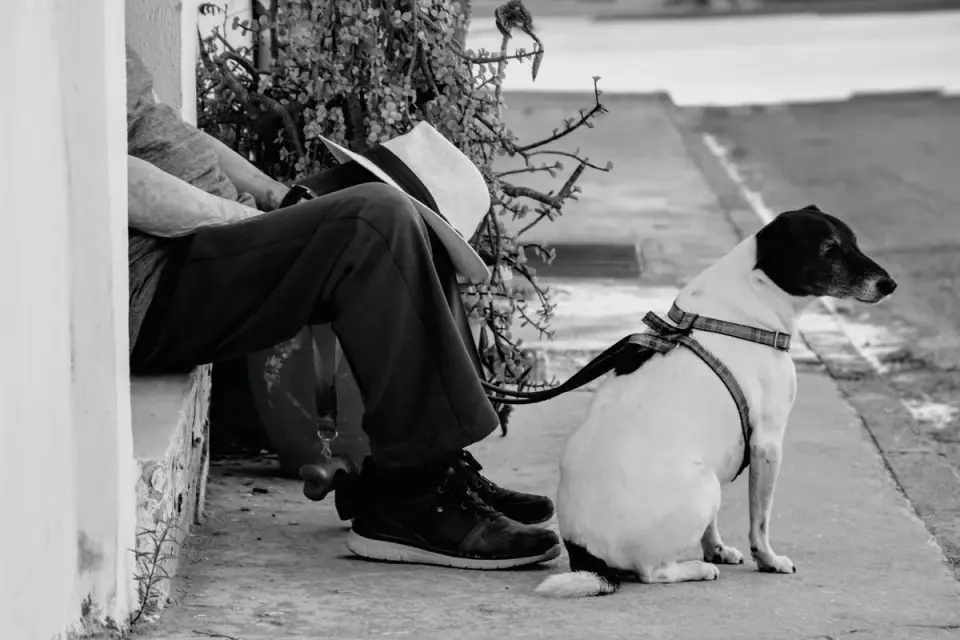
As she gets consistently loose and food-motivated at that distance across several sessions, you can shrink the gap by a few feet — not because a session went well once, but because it’s gone well repeatedly. Rushing this step is the most common reason owners tell me the technique “didn’t work” for their dog. It usually wasn’t the method; it was the pace.
What goes in your hand matters more than owners expect
Use something your dog rarely gets otherwise — shredded chicken, small cubes of cheese, freeze-dried liver — not the kibble sitting in the cabinet. The value of the reward needs to compete with the emotional weight of the trigger, and low-value treats simply don’t do that job. I ask owners to pick a food their dog would leave a nap for.
Some owners ask about calming supplements alongside this kind of training, and there’s a reasonable place for that conversation, with real caveats. Chamomile and L-theanine both show up in research on anxiety and stress, though the evidence base looks different depending on the ingredient and the species studied. A review in Biomedicines notes that for chamomile, “for the remaining species, evidence is derived mainly from preclinical studies or traditional use” — which is a fair way of saying we have promising signals, not proof, outside of a few well-studied contexts. L-theanine has more direct human data: a review in Molecular Psychiatry points to one study finding an effect on psychotic anxiety at a dose of 400 mg/day over eight weeks, while noting that most other trials didn’t find the same result. KSM-66 ashwagandha fares a bit better in the aggregate — a Cureus systematic review “analyzed multiple RCTs and concluded that ashwagandha has a moderate positive impact on stress reduction and cognitive performance.” I’ll say this plainly: none of that replaces the food-and-distance work above. A supplement may help take the edge off a jittery dog’s baseline arousal, but it isn’t going to teach her that the mail carrier isn’t a threat. That’s what the training does.
If your dog’s reactivity looks more like frustration at a fence line than true fear, it’s worth reading up on Barrier Frustration vs Aggression: What’s the Difference? before you assume counterconditioning is the right first tool — the two states call for different starting points.
When to manage instead of train, at least for now
Not every session needs to be a training session, and pretending otherwise is how dogs get flooded. If you’re walking past a trigger you can’t control for — an off-leash dog, a construction crew — it’s fine to simply create distance and move on without treats at all. That’s management, not failure. I wrote more on this distinction in Management vs Training: When to Just Avoid the Trigger, and I’d rather an owner manage a hard moment well than force a training rep that sets the dog back.
A short story that changed how I explain the pacing of this work: I once worked with a four-year-old rescue Shepherd mix, Nova, whose owner was doing everything textbook-correct except one thing — she was adding a cue word, “look,” right before the treats, because it felt more like “training” that way. Nova’s body language stayed tense for six straight weeks despite technically flawless open-bar timing. When we dropped the cue entirely and let the trigger itself be the only signal that predicted food, her shoulders started dropping within ten days. The cue had been quietly turning counterconditioning back into obedience, and that’s a swap I now ask every owner to watch for.
What this looks like week to week, and where I land
By week two, most dogs I work with are eating readily at their starting distance. By week four to six, many can tolerate the trigger noticeably closer without tensing. Some dogs, especially those with a longer fear history, take longer, and that’s not a sign the method has failed — it’s a sign the emotional shift is real and gradual rather than performed. I’d rather see slow, honest progress than a dog who looks “fixed” in a week because she’s simply learned to hold still.
If you’re also untangling whether what you’re seeing is fear-based reactivity versus something like resource guarding or overstimulation, Why Does My Dog Growl When I Pet Him? A Vet’s Guide to Reading the Warning is a useful next read, since the starting point changes the plan.
My bottom line, and I say this to every client who asks: open bar, closed bar is the technique I reach for first with a genuinely fearful dog, not corrections, not flooding, not hoping she “works it out.” The counterargument I hear most is that it’s slow and that a firmer hand gets faster results — and it’s true that suppression can look faster on video. But suppressed fear tends to resurface, often bigger, and I’d rather spend six patient weeks building a dog who’s actually less afraid than six days building one who’s just quieter about it.
Frequently asked questions
How long does open bar, closed bar training take to work?
Many dogs show looser body language at their starting distance within two weeks, with meaningful gains in how close they can tolerate a trigger by four to six weeks. Dogs with a longer fear history often need more time, and that's expected, not a sign of failure.
Can I use a cue word during open bar, closed bar sessions?
It's best to avoid one. The trigger itself should predict the treats — adding a verbal cue can quietly turn the exercise back into obedience training, which asks for a behavior rather than reshaping the emotional response underneath it.
What if my dog won't take treats near the trigger?
That's a sign you're too close. Back up until she can notice the trigger and still eat calmly, then build distance down gradually over repeated successful sessions rather than in one sitting.
Sources
- Chamomile and anxiety review — Biomedicines
- Ashwagandha systematic review — Cureus
- L-theanine and anxiety review — Molecular Psychiatry