Warm-Up Exercises Before a Dog Runs or Plays
A veterinary nutritionist and sports-medicine specialist explains how to warm up a dog before exercise, and why five minutes of prep matters more than most owners think.
Warm up a dog before exercise with five minutes of loose-lead walking and gentle joint movement, not a straight sprint from the car.
On this page
The first ten minutes at the dog park tell you almost everything. One dog trots in on a loose leash, sniffs the fence line, circles a little, and only then breaks into a run. Another comes out of the car already pulling, and within ninety seconds is airborne after a ball, cutting hard on a turn its body hasn’t had time to prepare for. I’ve watched both dogs for years in exam rooms, and the difference in how they move by age eight or nine is not subtle.
Why the first few minutes of movement matter more than owners assume
A cold muscle doesn’t lengthen the way a warm one does, and a joint that hasn’t moved through its range since the last walk isn’t lubricated the way it will be five minutes later. This isn’t unique to dogs — it’s the same physiology that has human athletes jog before they sprint — but dogs rarely get the courtesy of a warm-up. They go from crate to car to full-speed play in the time it takes an owner to unclip a leash. Compare that dog to one that spends five minutes walking and sniffing first: the second dog’s synovial fluid, the natural lubricant inside every joint, has had time to circulate and thin out, which is part of why gentle, gradual movement is generally recommended before higher-impact activity.
I ground that recommendation in the same logic I use when I talk about joint supplements: healthy synovial fluid is the cushion a dog’s cartilage depends on for pain-free movement, and ingredients like chondroitin are studied specifically because they support healthy synovial fluid homeostasis, according to a 2026 study in Frontiers in Veterinary Science. A warm-up doesn’t replace that biology — it activates it. Moving a joint through its normal range before asking it to absorb the force of a sprint or a hard landing is a low-cost, no-supplement way to give that same fluid a head start.
What an actual warm-up looks like, versus what most owners do instead
Most owners skip the warm-up entirely, and I understand why — the whole point of exercise time is often to burn off a dog’s energy as fast as possible. But there’s a real difference between the two approaches, and it shows up in what I see in the exam room over years, not weeks.
- No warm-up: dog exits the car or door already moving fast, launches into a sprint or hard play within the first minute, and the owner reports occasional limping “after really good runs.”
- Five-minute warm-up: dog walks on a loose lead for several minutes, sniffs and explores at its own pace, then transitions into a light trot before full speed is allowed.
That five-minute version isn’t complicated. Start with brisk, loose-leash walking — not a stroll, but not a run either — for three to five minutes. Let the dog change directions a few times as it sniffs; lateral movement wakes up stabilizing muscles that straight-line walking doesn’t touch. Then allow a minute or two of trotting before you unclip the leash or throw the first ball. For a dog headed into structured play, this sequencing matters more than the specific drill; the goal is simply graduated intensity, not a maximum effort within the first sixty seconds.
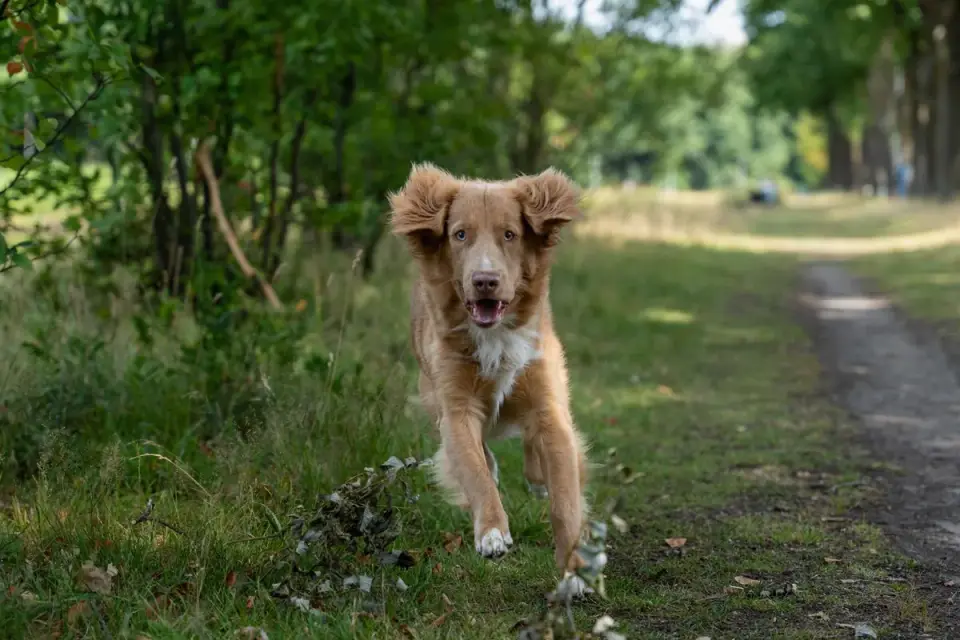
One dog I worked with, a five-year-old border collie named Scout who competed in weekend agility, came in because her owner noticed she was “slow to get going” on the first run of a trial day but fine by the third. We talked through her warm-up routine, which at the time was nonexistent — crate to ring, essentially. We built in a ten-minute walk-then-trot sequence before her first run, done every trial morning, rain or shine. Her owner told me months later that the first-run stiffness never showed up again. I can’t call that a study result; it’s one dog, one owner’s observation. But it lines up with what the physiology predicts, and it’s the kind of change that costs nothing and asks nothing of the dog except a slightly later start.
Where joint-support ingredients fit into this conversation, and where they don’t
Owners often ask me if a joint supplement is the warm-up, in the sense that it might let them skip the walking part. It doesn’t work that way, and I say so directly. Glucosamine and chondroitin are among the Journal of Veterinary Medical Science: most studied joint support ingredients for dogs, and glucosamine HCl in particular has been shown to help prevent experimentally induced cartilage degradation in vitro — meaningful, ongoing support for cartilage health over time, not a substitute for the mechanical act of warming a joint up before you load it. Green-lipped mussel powder has similarly been studied for its role in reducing inflammatory markers; in rodent models, green-lipped mussel preparations Nutrients: reduced serum levels of inflammatory markers including TNF-α and IL-17 alongside paw swelling. That’s inflammation-modulation research, not warm-up research, and I don’t conflate the two with clients. A supplement may help support a joint’s long-term resilience; only actual movement prepares that joint for what’s about to happen in the next thirty minutes.
If a dog already has diagnosed joint disease, the warm-up matters even more, and the activity choice afterward matters too — this is where I tell owners to think about swimming vs. walking for an arthritic dog rather than assuming every dog belongs at full-speed fetch. For a healthy adult dog, the bigger question is often how the warm-up interacts with the exercise itself: a dog headed for off-leash play versus an on-leash walk needs a different warm-up runway than one headed for a slow, structured walk, simply because the peak intensity arrives so much faster in unstructured play.
The verdict I actually give owners
By the time a dog reaches me for a joint consult, the damage — if there is any — has usually been accumulating for years, not weeks, so I never oversell what a single change can do. But warming up before exercise is one of the few genuinely free interventions in a dog’s exercise routine, and I recommend it to every owner regardless of age or activity level. Five minutes of loose-leash walking, a short stretch of trotting, then full activity. It costs nothing, it takes no supplement, and it asks only that the dog’s first minute outside not be its most demanding one.
For dogs already showing joint sensitivity, pair that warm-up habit with a broader look at how a dog’s daily walk length should be structured, and don’t assume every high-energy game — like a session of fetch versus a structured walk — carries the same joint load. The warm-up is the same five minutes either way; what changes is how much intensity you let the dog reach afterward.
Frequently asked questions
How long should a dog warm up before running or playing?
Three to five minutes of brisk, loose-leash walking followed by a minute or two of light trotting is generally enough to prepare muscles and joints before higher-intensity activity.
Do older dogs need a longer warm-up than young dogs?
Many older dogs and dogs with diagnosed joint conditions benefit from a longer, more gradual warm-up, since stiffness and reduced range of motion are more common with age.
Can a joint supplement replace a warm-up?
No. Ingredients like glucosamine, chondroitin, and green-lipped mussel are studied for long-term joint support, not for preparing a joint for immediate activity — the warm-up itself is a separate, mechanical step.
Sources
- Chondroitin sulfate and joint homeostasis in dogs — Frontiers in Veterinary Science
- Glucosamine HCl and cartilage degradation — Journal of Veterinary Medical Science
- Green-lipped mussel powder and inflammatory markers — Nutrients