What Calming Signals Tell You About Your Dog
A vet's guide to reading canine calming signals — lip licks, yawns, turned heads, and slow blinks — and what to actually do once you see them.
Calming signals are your dog's early warning system. Learn to read them and you can often defuse tension before it becomes a bite.

On this page
A beagle mix named Dot taught me more about calming signals than any textbook did. She was about four years old, maybe 22 pounds, and her owner brought her in because “she freezes sometimes at the vet, but she’s fine at home.” When I crouched down to greet her in the exam room, Dot didn’t growl or back away. She turned her head to the side, licked her lips twice, and gave a long, slow yawn — at 9 a.m., with no reason to be tired. Her owner laughed and said, “She does that in the car too.” That yawn, that head turn, that lip lick: those are calming signals, and Dot was telling both of us, as clearly as a dog can, that she needed a slower approach.
Calming signals are the small, mostly involuntary behaviors dogs use to lower tension — in themselves, in another dog, or in a person. The term comes from ethologist Turid Rugaas’s work observing dogs, and while not every trainer or vet behaviorist uses her exact catalog, the underlying idea holds up well in clinical practice: dogs give you a lot of information before things escalate, and most owners are never taught to look for it.
What calming signals actually look like
The signals themselves are subtle enough that owners often mistake them for something else entirely — boredom, sleepiness, or just “being a weird dog.” In my exam rooms, the ones I see most often are:
- Lip licking or tongue flicks with no food nearby
- Yawning outside of naptime, especially several yawns close together
- Turning the head or whole body away from a person, dog, or object
- Slow blinking or averted eye contact, sometimes paired with a soft, relaxed-looking face that reads as “calm” to an untrained eye but is actually effortful
- Sniffing the ground suddenly, mid-interaction, for no obvious scent reason
- Shaking off, like they’re wet, when they’re completely dry
- Freezing or moving in a slow, stiff arc rather than a straight line toward another dog
None of these, on their own, means a dog is in crisis. A single yawn is just a yawn sometimes. What matters is context and clustering — a dog who yawns, licks its lips, and turns away within a few seconds of a stranger reaching for its head is telling you something different than a dog who yawns once on the couch after a walk.
Why the signal matters more than the label
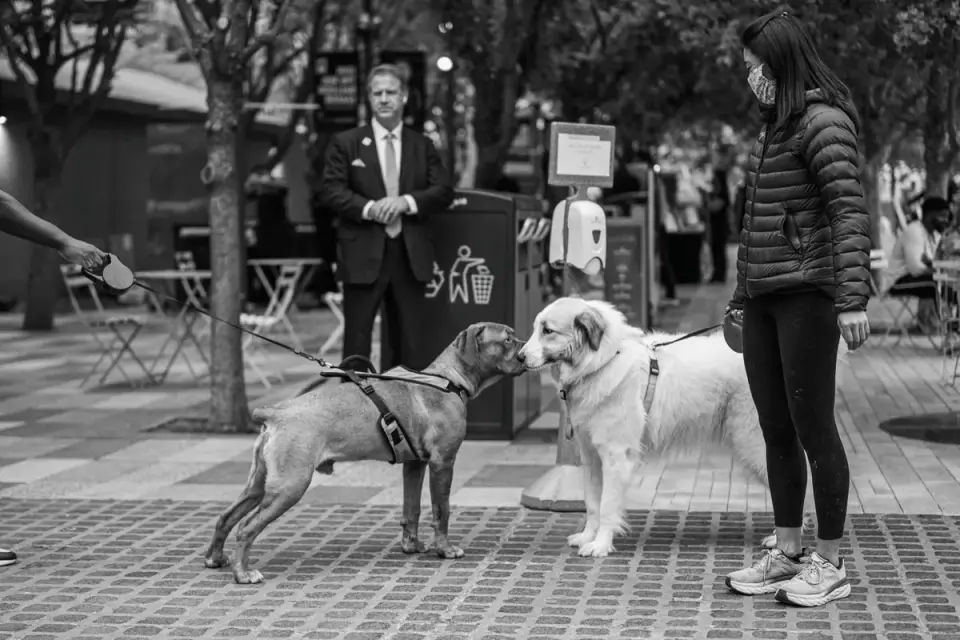
I’ll be direct about where I land on this, because owners want a plan, not a taxonomy. The value of learning calming signals isn’t memorizing a checklist — it’s building the habit of pausing when you see one. A dog who licks their lips when a toddler leans in for a hug is asking for space, not being “difficult.” A dog who turns away from another dog at the fence is trying to de-escalate, not being rude. When you respond to the signal — back off a step, slow your hands down, give the dog an exit — you’re rewarding the strategy that keeps things calm instead of the strategy that comes next, which is usually a growl or a snap.
Some trainers argue the opposite: that focusing too much on subtle signals makes owners hypervigilant and turns every yawn into a crisis. I understand the concern, but in my experience it’s rarely the actual failure mode. Far more often, owners miss the signals entirely and only intervene once the dog has already escalated to a warning growl or a snap — at which point the dog has learned that quiet signals don’t work and loud ones do. Teaching a dog that a lip lick is enough to get space is a better long-term strategy than waiting for a growl to do the same job.
This is also where calming signals overlap with, but aren’t identical to, play behavior. A play bow can look loose and relaxed while still sitting right next to genuine tension in a multi-dog household — see Play Bow or Aggression? Reading Dog-to-Dog Signals for how to tell those apart. And a dog who’s stuck behind a fence or gate showing calming signals toward another dog is a very different situation from one showing true aggression; that distinction is covered in Barrier Frustration vs Aggression: What’s the Difference?
What I’d actually tell you to do tonight
Start by watching, not fixing. For one week, notice when your dog yawns, licks their lips, or turns away, and jot down what was happening in that moment — a visitor at the door, a hug from a kid, another dog approaching on a walk. You’ll usually see a pattern faster than you expect.
Once you see the pattern, change your own behavior first. If your dog licks their lips every time a stranger reaches over their head to pet them, ask people to let your dog approach instead, and to pet the chest or shoulder rather than reaching over the head. If your dog turns away from other dogs at a specific distance on walks, that distance is information — it’s roughly where your dog’s comfort ends, and it’s worth respecting rather than closing.
I had a client with a young shepherd mix, Wren, who’d bark and lunge at the mail carrier every single day at 2 p.m. When we slowed the video down (her owner had a doorbell camera), Wren gave three lip licks and a full-body shake-off in the ten seconds before the barking started — every time. Once her owner started intervening at the lip lick instead of the lunge, calling Wren away and rewarding the retreat, the daily barking episode dropped from a near-daily event to a few times a month within about six weeks. That’s one dog’s timeline, not a promise of what yours will look like, but it shows how much room there often is between the first signal and the blow-up most owners are trying to prevent.
If your dog’s signals are frequent, intense, or tied to chronic stressors — a new baby, a move, ongoing conflict with another household dog — that’s worth a conversation with your vet or a certified behaviorist rather than something to manage with observation alone. Chronic, low-level stress is also where some owners start asking about calming supplements as one piece of a broader plan, not a replacement for the behavior work above. The evidence there is mixed and worth knowing before you spend money on it. For chamomile, a traditional calming botanical, evidence in most species is derived mainly from preclinical studies or traditional use rather than controlled trials, according to a 2026 review in Biomedicines. L-theanine, an amino acid found in tea, has been studied for its calming properties, and in human research it showed benefit in at least one study on anxiety, at a dose of 400 mg/day for 8 weeks, per a review in Molecular Psychiatry. Ashwagandha has similarly shown a moderate positive impact on stress reduction in a systematic review published in Cureus analyzing multiple human RCTs — worth knowing, but not yet established the same way in dogs, and no substitute for the behavior work above.
Where this lands
None of this replaces reading your own dog. Calming signals are a language, and like any language, fluency comes from paying attention over and over, not from a single article. Distinguishing separation-related distress from ordinary boredom is a related skill worth building — see Boredom vs Separation Anxiety: How to Tell the Difference — because the calming signals a stressed dog shows when left alone can look almost identical to the ones a bored dog shows out of habit, and the fix is different for each.
My honest advice, the same thing I tell owners in the exam room: don’t wait for the growl. The yawn, the lip lick, the turned head — they’re not decoration. They’re your dog’s first, quietest request. Answer that one, and you’ll see the loud ones a lot less often.
Frequently asked questions
Are calming signals the same as body language in general?
They're a subset of it. Calming signals are specifically the behaviors dogs use to de-escalate tension — lip licks, yawns, head turns, sniffing — rather than the full range of canine communication, which also includes things like play bows, tail carriage, and vocalizations.
Can a dog show calming signals and still bite?
Yes. Calming signals are an early request for space, not a guarantee of safety. If they're ignored repeatedly, a dog often escalates to growling, snapping, or biting because the quieter signal didn't work.
Do puppies show calming signals?
Many do, though the vocabulary is still developing. Puppies often show exaggerated versions — lots of lip licking, rolling over, or freezing — and benefit from owners who respond to those cues early rather than pushing through them.
Sources
- Effects of Botanicals on Anxiety and Stress in Companion Animals — Biomedicines
- Systematic Review of Ashwagandha (KSM-66) and Stress Reduction — Cureus
- L-Theanine and Anxiety: A Review — Molecular Psychiatry