Dog Park vs Structured Exercise for Your Dog
Is the dog park good exercise, or is it mostly stimulation with a side of risk? A vet nutritionist walks through what each format actually does for a dog's body.
The dog park delivers stimulation and socialization fast, but structured exercise is what actually builds and protects a dog's joints over time.
On this page
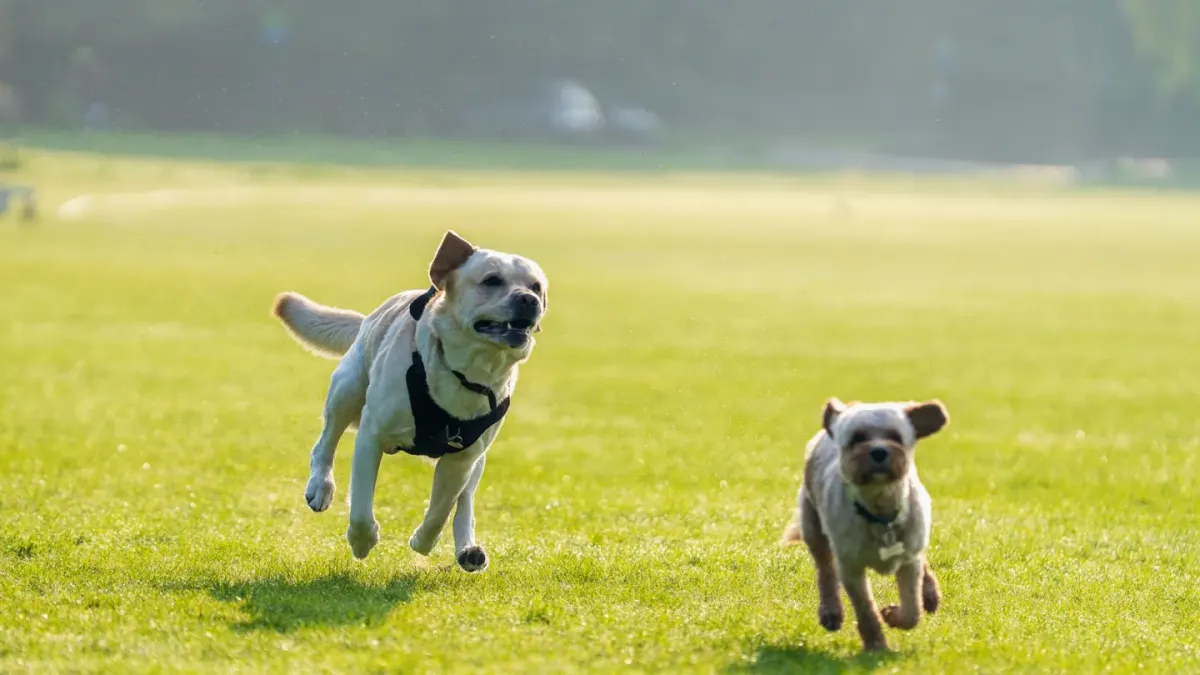
Six-thirty on a Tuesday, and the dog park lot is already half full. A three-year-old Labrador named Otis comes barreling out of the owner’s hatchback, hits the gate at a dead sprint, and spends the next forty minutes in stop-start chases with a rotating cast of strangers’ dogs. His owner checks her phone. Otis pants hard on the drive home, sleeps most of the evening, and by Thursday is favoring his right shoulder slightly going down the porch steps. Nothing dramatic. Just a hitch in the gait that wasn’t there Monday.
I’ve watched some version of that week play out often enough that I no longer treat it as a coincidence. In my practice, the dogs who come in with soft-tissue strains, toe injuries, and flare-ups of early joint disease cluster around two exposures: unrestricted dog-park sprinting and sudden weekend-warrior hikes after a sedentary week. Neither is inherently reckless. Both ask a dog’s tendons, ligaments, and joint cartilage to absorb forces they haven’t been conditioned for. The question owners actually want answered — is the dog park good exercise — deserves a more specific answer than yes or no.
What a dog park actually gives a dog
A dog park is, functionally, unstructured high-intensity interval activity layered on top of intense social and sensory stimulation. That combination is genuinely valuable. Off-leash sprinting, wrestling, and chase games build cardiovascular fitness quickly, and the social component matters for behavioral health in a way a solo walk never will. For a well-socialized, physically sound adult dog, an hour at a good park can do more for mental fatigue than two hours of leash walking.
The tradeoff is load control. At the park, your dog decides the pace, the direction changes, and the play partner — you don’t. A 60-pound dog making a hard lateral cut to intercept a ball, then getting body-checked by a 40-pound dog moving the opposite direction, generates rotational forces on the knees and hips that a structured walk or run never produces. That’s not a reason to avoid parks. It’s a reason to think of park time as high-variance exercise, more like a pickup basketball game than a training session.
Where structured exercise earns its keep
Structured exercise — leash walks at a controlled pace, fetch on a straight line, swimming, treadmill work, hill sets — trades some of that stimulation for control over intensity, direction, and duration. That control is exactly what builds durable fitness without accumulating micro-trauma. It’s also how you actually condition a dog for the unstructured stuff: a dog with a base of controlled aerobic work tolerates a chaotic dog-park session far better than one whose only exercise is the park itself.
Our related guide on how long a dog’s walk should be gets into building that base by age and body condition rather than a fixed number, and it’s worth reading before you decide how much unstructured play to layer on top. Structured sessions are also where you can actually manage environmental risk — our pavement-test guide for hot-weather walking is a good example of a variable you can control on a walk that you can’t control at a crowded, sun-baked dog park in August.

The joint question nobody asks until it’s a problem
This is where I want to be direct, because it’s the part owners skip. Repetitive high-force loading — the kind a dog park produces in concentrated bursts — accelerates wear on joint cartilage over a dog’s lifetime, especially in large and giant breeds or dogs with any existing joint laxity. Chondroitin, one of the more studied joint-support ingredients, has been shown to support healthy synovial fluid homeostasis, the fluid that cushions and lubricates the joint during exactly this kind of loading, according to a Frontiers in Veterinary Science review. Glucosamine HCl, its usual companion ingredient, has been shown in vitro to help prevent experimentally induced cartilage degradation, per a review in the Journal of Veterinary Medical Science. Neither finding means a supplement offsets reckless exercise; it means the cartilage stress from repetitive hard play is real enough that researchers study how to protect it.
Green-lipped mussel is the other ingredient I get asked about most, usually by owners of dogs already showing stiffness after activity. In a Nutrients study, mussel-derived compounds alleviated paw swelling and reduced markers of inflammation in an animal model of joint disease. That’s an inflammatory model, not a dog-park injury study, so I won’t stretch it further than that. What I will say, as someone who weighs what a supplement can realistically do for a dog’s mobility: none of these ingredients substitute for appropriate exercise intensity. They’re a support layer under good loading habits, not a fix for bad ones.
Here’s the short version: no supplement outruns a joint that’s being asked to do too much, too fast, too often.
Building a week that uses both well
Don’t treat this as an either-or choice. Use structured exercise as the base and the dog park as the reward layer.
- Anchor most days with a controlled walk or jog sized to your dog’s age, breed, and body condition.
- Reserve the dog park for one or two sessions a week, and go earlier or later when it’s less crowded and less frantic.
- Warm up with five minutes of leash walking before you let your dog off-lead to sprint.
- Watch for a limp, a slow rise from lying down, or reluctance on stairs in the 24 to 48 hours after a hard park session — that’s your dog telling you the load was too much this time.
- Skip the park entirely on days your dog is already stiff, recovering, or older than roughly seven for a large breed.
The verdict, and the honest tradeoff
Back to Otis for a second. His owner didn’t stop going to the dog park — she just stopped making it his only exercise. She added two structured 25-minute walks a week, capped park visits at three per week, and started watching his gait the morning after. Six weeks later the hitch hadn’t come back. That’s one dog, not a study, but it’s the pattern I see often enough to recommend it as a starting framework rather than a guess.
So is the dog park good exercise? Yes, as a supplement to a structured base — never as the whole program. If you’re building your dog’s week from scratch, our Whole-Dog Wellness starting guide is a reasonable place to set that foundation before you decide how much off-leash chaos to add on top. What would change if you tracked your dog’s gait the morning after their next park visit, instead of assuming a good run is always a good day for their joints?
Frequently asked questions
Is the dog park good exercise for every dog?
Not automatically. It's excellent for socialization and cardiovascular bursts in healthy, well-conditioned adult dogs, but it's a poor primary exercise plan for puppies with open growth plates, seniors, or dogs with existing joint disease, who benefit more from controlled, structured activity.
How often should a dog go to the dog park if they also get structured walks?
One to two sessions a week is a reasonable starting point for most healthy adult dogs, layered on top of a daily structured walk sized to their age and body condition.
Sources
- Protective effects of turmerosaccharides rich extract of Curcuma longa L. in osteoarthritic dogs — Frontiers in Veterinary Science
- Glucosamine and cartilage protection: an in vitro review — Journal of Veterinary Medical Science
- Green-lipped mussel compounds and inflammatory joint markers — Nutrients