Exercising Your Dog as a Busy, Time-Crunched Owner
A veterinary nutritionist and sports-medicine plan for exercising a dog around a full workday — morning, midday, and evening routines by age and joint risk.
A tired dog is not the goal on a workday — a dog that can move well tomorrow matters more.

On this page
Tuesday starts at 6 a.m., the alarm goes off, and a 4-year-old 52-pound pit mix is already pacing by the door with a leash in his mouth. His owner works ten-hour hospital shifts, leaves by 7, and used to feel guilty that one rushed loop around the block was all she could offer. By day 10 on a split routine — brisk walk plus training games in the morning, a midday sniff break, and controlled play in the evening — the pacing at the door stopped and the evening zoomies settled into sleep by 9 p.m. That shift is the whole decision for a time-crunched owner: stop chasing one exhausting workout and build movement into the seams of the workday.
The workday checklist I give busy owners:
- Anchor the day with 15–20 minutes of brisk, leashed movement before work
- Outsource midday movement: walker, daycare 1–2x/week, or a 10-minute sniff break
- Trade one long weekend blast for two short evening sessions of play plus training
- Match intensity to age, weight, and joint history — not breed energy alone
- Warm up 3–5 minutes before hard play, cool down after
- Feed for recovery: complete diet first, joint ingredients as support where the evidence fits
The morning block that sets the whole day
Mornings do the most work for the least time. A brisk 15- to 20-minute walk with 3–4 minutes of obedience interspersed — sit, touch, place, loose-leash turns — tires the brain and warms muscle better than a frantic sprint before you leave. I prioritize nose work here too: scatter half of breakfast in grass for five minutes. Food therapy thinking applies: a complete, balanced diet that maintains lean body condition does more for mobility and recovery than any powder added later.
That failed weekend pattern is worth naming. A 6-year-old 71-pound Labrador I followed lived quietly Monday through Friday, then did two hours of hard fetch every Saturday at the park. Three weeks in he came home stiff, slow on stairs Sunday morning, and unwilling to jump into the car. The owner thought he needed more stamina work. He needed the opposite — distributed load. Repetitive sprint-stop loading without conditioning is a classic setup for soft-tissue strain, which is why I steer busy owners away from making Saturday the make-up day. A steadier approach to warm-up exercises before a dog runs or plays prevents more missed workdays than any supplement can.
What midday should actually do
Midday is maintenance, not fitness. A 10-minute on-leash sniff walk, a walker visit, or puzzle feeding breaks up crate or couch time and lowers the evening arousal spike that drives destructive chewing. If you use a walker, ask for structured walking over prolonged ball chasing, especially for adolescents and seniors. The comparison I return to is off-leash play vs. on-leash walks — both have a place, but leashed rhythm builds consistent aerobic work without the joint spikes of chaotic play.
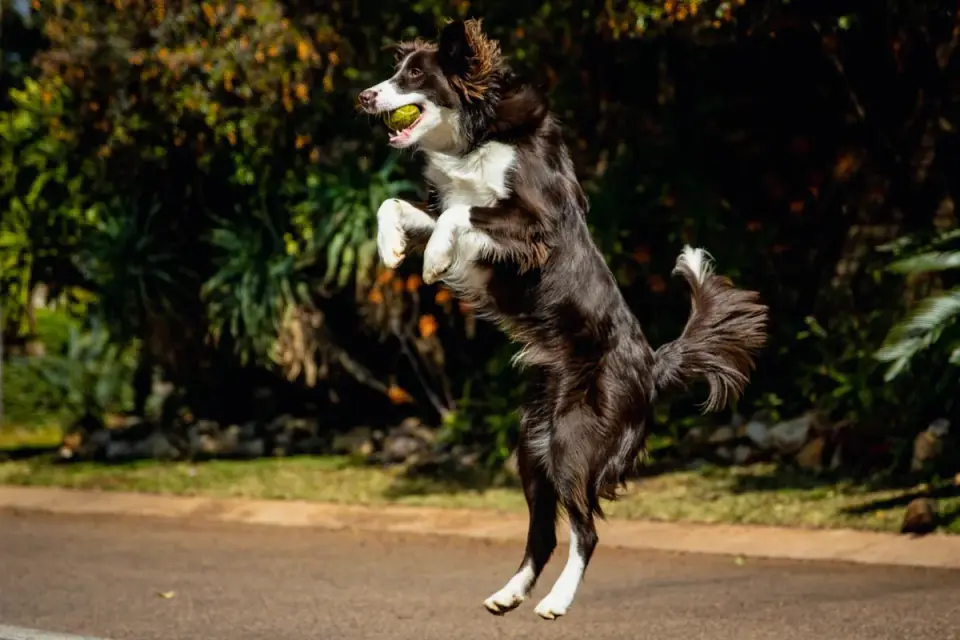
Evenings: spend energy without spending joints
Evenings are for skill plus short bursts. Two 10-minute blocks beat one hour-long free-for-all: first a walk to decompress from your absence, then tug, flirt-pole with rules, or two to three short retrieves on grass with clear stops. End with two minutes of easy walking to cool down. Owners who love fetch should read the tradeoffs in fetch vs. structured walks for exercise before they build the whole week around it.
The edge case that changes the plan is the older dog who still looks athletic. An 11-year-old 19-pound miniature poodle I monitored could still trot for miles, but by day 14 of added evening fetch she began lagging on the last block and licking a front carpus at night. Her owner read it as laziness. It was load intolerance with age. We cut retrieves, kept brisk walks and incline sniffing, and added two rest days. Senior dogs often need frequency preserved and intensity trimmed — shorter, more predictable movement protects the joints that have to last.
Where joint nutrition fits, and where it does not
Food, weight, and conditioning drive joint health first. A supplement can realistically do one thing: help support the structures around diet, mobility, and recovery while the exercise plan does the heavy lifting. That is my evidence-bounded position.
Grounding that in nutritional evidence, glucosamine and chondroitin are among the most studied joint support ingredients for dogs, and the trial literature gives them narrow, structure-focused roles. One peer-reviewed report described by Frontiers in Veterinary Science found chondroitin “supports healthy synovial fluid homeostasis.” Laboratory work summarized by the Journal of Veterinary Medical Science found glucosamine HCl “prevent experimentally induced cartilage degradation in vitro.” For green-lipped mussel, investigators writing in Nutrients reported that “BMO, GMO, and KO all alleviated paw swelling in rats and reduced serum levels of rheumatoid factor (RF), anti-cyclic citrullinated peptide (anti-CCP) antibody, and pro-inflammatory cytokines such as TNF-α and IL-17.”
The strongest counterargument is fair: if those findings are largely in vitro or in rats, why bother at all for a busy dog? I still land on limited, honest use — a well-formulated joint supplement may help support mobility alongside weight control and consistent exercise, but it cannot condition tissue or undo a weekend-warrior pattern. Avoid the common dog exercise mistakes owners make first, then add nutrition support if your veterinarian agrees.
Short work still compounds.
A week you can keep when work runs long
Monday through Friday: morning brisk walk plus breakfast scatter, midday break as available, evening walk plus one play-training block. Saturday: one longer sniff hike, no extra fetch volume. Sunday: rest or easy walk. When travel or overtime hits, keep the morning anchor and drop the evening intensity — consistency protects joints more than occasional exhaustion ever will.
Frequently asked questions
How much exercise does my dog need if I work all day?
Most adult dogs do well with 30–45 minutes of total movement split into 2–3 short sessions plus mental work, adjusted for age, weight, and joint health. Keep the morning walk non-negotiable and vary evening intensity.
Is a long weekend workout enough to make up for a quiet week?
No. Concentrated hard exercise after five quiet days raises soreness and injury risk. Spread shorter walks, sniffing, and controlled play across the week instead.
Should a busy owner use a joint supplement?
Diet, lean weight, and consistent conditioning come first. Joint ingredients like glucosamine, chondroitin, and green-lipped mussel may help support mobility and joint structures, but they do not replace exercise planning — ask your veterinarian what fits your dog.
Sources
- Synovial fluid homeostasis study — Frontiers in Veterinary Science
- Cartilage degradation in vitro study — Journal of Veterinary Medical Science
- Mussel oil paw swelling study — Nutrients