Off-Leash Play vs. On-Leash Walks: Which One Actually Exercises Your Dog?
A veterinary sports-medicine view on when off-leash play earns its keep, when a leash walk is the better joint choice, and how to combine both without overloading a dog's body.
Off-leash bursts build fitness fast; the leash mile is what actually protects the joints doing the work.
On this page
Should your dog’s exercise come from an open field or the end of a leash? Owners ask me this constantly, and the honest answer is that the two aren’t interchangeable — they load a dog’s body in genuinely different ways, and picking the wrong one for the wrong dog is how I end up seeing lameness cases that didn’t need to happen.
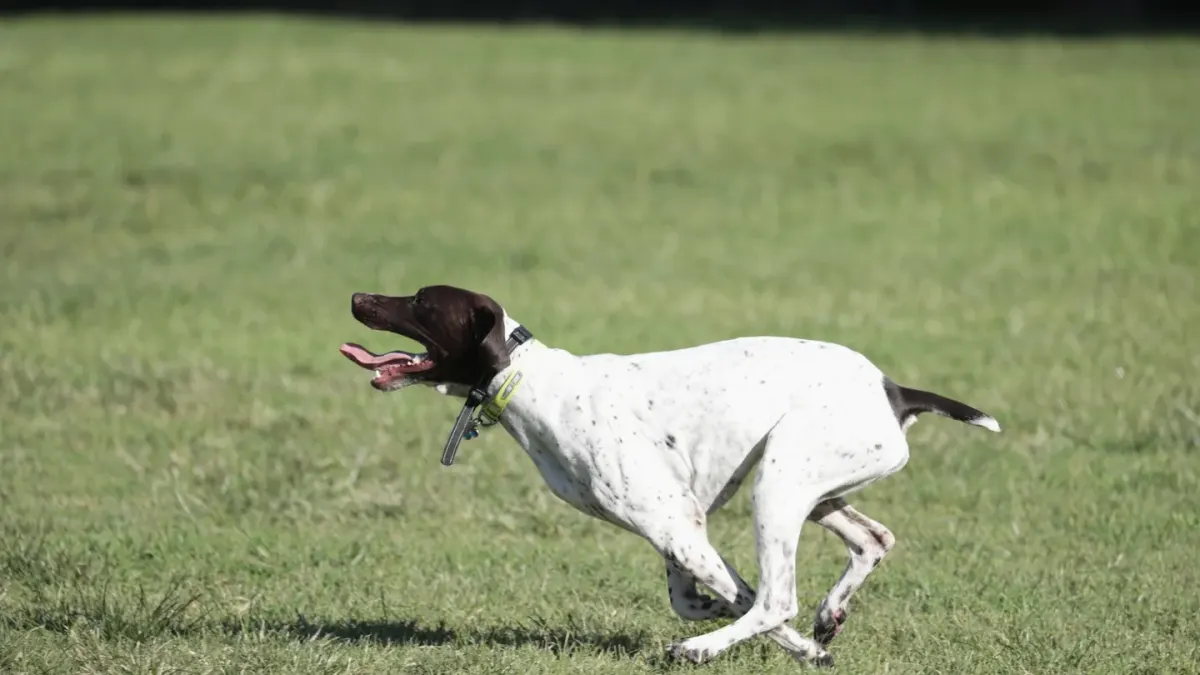
A leash walk is steady-state, low-impact, and controllable. A dog’s stride length, speed, and surface are mostly fixed by the human on the other end. Off-leash play — fetch, chasing another dog, sudden direction changes — is high-variability, high-impact, and largely uncontrollable. It’s the difference between a treadmill and a pickup basketball game. Both are exercise. Neither substitutes cleanly for the other, and the dog in front of you determines which one you should be leaning on this week.
Why the loading pattern matters more than the calorie burn
Owners tend to think about exercise the way they think about their own workouts: minutes, distance, calories. That framing misses the variable that actually predicts injury and joint wear in dogs, which is loading pattern — how much force goes through a joint, how fast, and how many times.
A brisk on-leash walk produces repetitive, symmetrical, moderate loading. It’s the canine equivalent of a long steady jog: unglamorous, low risk, and cumulative in its benefit. Off-leash play produces the opposite profile — short bursts of high-speed, asymmetrical loading, especially during the plant-and-cut motion of chasing a ball or another dog. That cutting motion is exactly what stresses the stifle (knee) and shoulder most. It’s also the more effective driver of cardiovascular fitness and true range-of-motion work, because a dog rarely gets into a full gallop, a hard turn, or a full extension trot on a six-foot leash.
The dog I think about when owners ask this question
In my practice I’ve watched this play out with a five-year-old Labrador named a client brought in after a weekend at the lake — sixty pounds, previously fit, no prior lameness. He’d spent two straight days doing hard fetch-and-retrieve into the water, sprinting and pivoting on wet grass between throws. By Sunday night he was three-legged lame on a hind limb. On exam he had stifle effusion and a positive drawer sign consistent with a partial cruciate injury. The owner’s first question was whether the swimming had done it — it hadn’t. It was the repeated hard deceleration and pivot on an unstable surface, done for two days straight with no conditioning buildup, that overloaded a joint that had never had to move that way before. That dog spent the next ten weeks on leash-only, surface-controlled walks while the joint settled, which is a hard conversation to have with an owner who thought leash walks were the boring, lesser form of exercise.
What each style is actually good for
Neither style is inherently better — they’re suited to different goals, and a well-exercised dog usually gets both in the right proportions.
On-leash walks earn their keep on:
- Predictable, repeatable daily mileage that builds aerobic base without joint spikes
- Controlled recovery exercise for dogs coming back from injury or surgery
- Weight management, where consistency matters more than intensity
- Senior dogs and dogs with diagnosed joint disease, where a controlled pace protects a compromised joint
Off-leash play earns its keep on:
- Genuine cardiovascular conditioning — most dogs simply don’t hit a real gallop on a leash
- Mental stimulation and species-typical behavior (sniffing, chasing, social play)
- Full range-of-motion work through the shoulder, spine, and hip that a walk rarely demands
If your dog is young, healthy, and well-conditioned, a mix of both is ideal: a daily leash walk as the base, with off-leash sessions layered in a few times a week, built up gradually rather than sprung on the dog after a sedentary week. If you’re still calibrating how much daily leash mileage your dog needs before adding play on top, How Long Should a Dog’s Walk Be? walks through that math by age and body condition.
Where joint supplements fit into this conversation — and where they don’t
I get asked, almost every time this topic comes up, whether a joint supplement lets a dog handle more off-leash intensity safely. It doesn’t work that way, and I’d rather say that plainly than let an owner think a chew is a substitute for conditioning. What a joint supplement can realistically do is support the tissue that’s already under load from whatever exercise the dog is doing — it’s not a license to skip the buildup phase.
The evidence base here is real, but it’s narrower than the marketing suggests. A review in the Journal of Veterinary Medical Science found that glucosamine HCl can help prevent experimentally induced cartilage degradation in vitro — a laboratory finding, not a guarantee of protection during a hard weekend of fetch. Chondroitin has similarly been studied for its role in joint tissue: a paper in Frontiers in Veterinary Science reports that it supports healthy synovial fluid homeostasis, the fluid that cushions and lubricates the joint during movement. And green-lipped mussel powder, a common joint-support ingredient, showed anti-inflammatory activity in a rat model published in Nutrients, where it alleviated paw swelling and reduced markers like TNF-α and IL-17 — evidence of biological plausibility in an animal model, not a clinical claim about dogs at play.
None of that replaces a conditioning plan. If a dog’s stifle isn’t ready for hard cutting motion, no amount of chondroitin changes the physics of that pivot. Weigh what a supplement can realistically do for diet, mobility, and recovery, and use it as one part of a joint-support plan built around appropriate exercise — not as the reason to skip the buildup.

Building a week that uses both well
I tell owners to stop thinking in either/or terms and start thinking in a weekly template. A rough version I give clients with a healthy adult dog: daily leash walks of twenty to forty minutes as the base, two to three off-leash play sessions built up gradually in duration and intensity, and at least one full rest day. Puppies and seniors need that ratio shifted heavily toward the controlled end — puppies because their growth plates aren’t ready for hard impact, seniors because joint reserve is already reduced.
Surface and temperature matter as much as the leash-versus-off-leash question itself. Hard cutting on pavement is harder on joints than the same motion on grass, and heat changes a dog’s tolerance for either style of exercise. If you’re planning a hot-weather play or walk session, When Is It Too Hot to Walk a Dog? covers the pavement test I use with clients before either activity.
If you’re building a broader exercise and nutrition plan from scratch, Whole-Dog Wellness: A Practical Starting Guide is the place I’d point a new owner before layering in the specifics covered here.
The verdict I give owners
A dog that only walks on leash is missing real cardiovascular fitness and species-typical movement. A dog that only gets hard off-leash bursts, with no conditioning base, is a lameness case waiting for a wet Saturday at the lake. Build the leash mile first, add off-leash intensity gradually, and match both to the joints your dog actually has — not the ones you wish they had.
Frequently asked questions
Is off-leash play better exercise than a leash walk?
Off-leash play generally delivers better cardiovascular fitness and range of motion because dogs can reach speeds and movement patterns a leash restricts, but leash walks provide the steady, low-impact, repeatable loading that most joints need every day. A well-exercised dog usually gets both.
Can a joint supplement let my dog do more off-leash play safely?
No supplement replaces a conditioning buildup. Ingredients like glucosamine, chondroitin, and green-lipped mussel are studied for supporting joint tissue and synovial fluid, but they don't change the physics of a hard pivot on an unconditioned joint.
How much off-leash play is too much for a dog who mostly walks on leash?
Any dog going from mostly sedentary or leash-only exercise into hard fetch or chase play is at higher injury risk. Build off-leash intensity and duration up gradually over several weeks rather than doing a single hard weekend session.
Sources
- Protective effects of turmerosaccharides rich extract of Curcuma longa L. in osteoarthritic dogs — Frontiers in Veterinary Science
- Glucosamine HCl and cartilage degradation — Journal of Veterinary Medical Science
- Blue Mussel Oil, Green Mussel Oil, and Krill Oil in adjuvant-induced arthritis — Nutrients