Fetch vs. Structured Walks: Which Exercise Actually Serves Your Dog Better?
A veterinary nutritionist and sports-medicine specialist compares fetch and structured walking for daily dog exercise, weighing joint load, mental engagement, and what actually builds a sustainable routine.
Fetch burns energy fast, but a structured walk builds the steady, joint-friendly fitness most dogs actually need day after day.

On this page
A young Labrador I worked with, Cooper, was the neighborhood’s designated fetch machine. His owners threw a ball for him every evening after work, forty, fifty throws sometimes, because it tired him out fast and they were short on time. By age five, Cooper had started slowing down after the third or fourth sprint, hesitating before jumping into the car, and his owners assumed it was just getting older. What they were actually describing was cumulative joint loading from thousands of hard stops, pivots, and sudden decelerations, the kind of repetitive high-impact stress that a thirty-minute walk almost never produces.
That’s the tension at the center of this question. Fetch and walking both count as “exercise,” but they load a dog’s body in very different ways, and which one is better depends heavily on what you’re actually trying to accomplish.
What fetch does to a dog’s body that walking doesn’t
Fetch is anaerobic. A dog sprinting after a ball hits near-max heart rate in seconds, then slams on the brakes, pivots, and does it again. That deceleration-and-pivot pattern concentrates force through the stifle, hock, and shoulder in a way a walk never will. It’s genuinely great cardio, and for a healthy young dog with good conformation, occasional fetch sessions are fine and even useful for building explosive muscle tone. The problem is repetition without recovery. Twenty or thirty throws back to back, several times a week, asks connective tissue to absorb the same shearing forces over and over with no time to adapt.
I’ve watched this play out with working-breed dogs especially — Border Collies and retrievers whose drive outpaces their joints’ tolerance for the activity. Owners keep throwing because the dog keeps chasing; the dog doesn’t self-regulate the way a walking pace naturally does. That’s a meaningful distinction for anyone weighing fetch as a primary exercise plan rather than an occasional treat.
What a structured walk builds instead
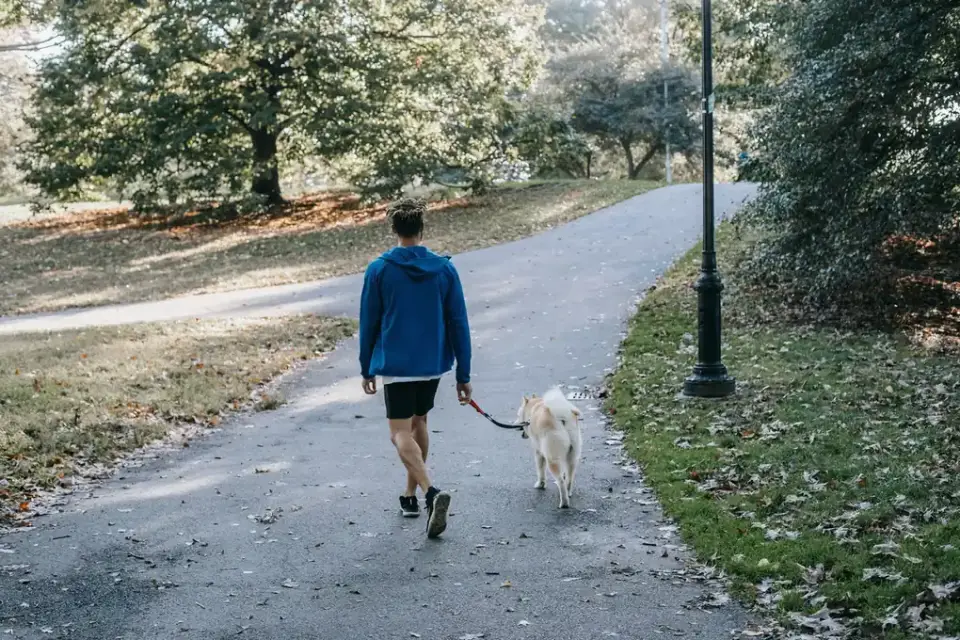
A walk is aerobic, low-impact, and repeatable almost every single day without the same wear-and-tear tradeoff. It builds cardiovascular endurance and lean muscle gradually, and it gives a dog’s joints, tendons, and ligaments time to strengthen rather than just absorb shock. Walking also does something fetch mostly skips: it feeds a dog’s nose. Sniffing a new route, working scent trails along a fence line, and reading the neighborhood’s overnight news is mentally taxing in a good way, and that kind of low-grade cognitive engagement is part of why a well-walked dog tends to settle better at home. If you’re still dialing in how much walking is actually enough for your dog’s age and energy level, our guide on how long should a dog’s walk be breaks that down by life stage.

Here’s the short version: fetch spends energy, walking builds fitness. Those aren’t the same job, and mixing them up is where a lot of routines go wrong.
Where joint health tips the scale
This is where I’d ask an owner to weigh what their dog’s joints can realistically absorb, because the two activities aren’t interchangeable once a dog has any orthopedic history. Puppies with open growth plates, large-breed dogs with a family history of hip or elbow dysplasia, and any dog recovering from a soft-tissue injury should treat fetch as an occasional, carefully limited activity rather than a daily habit. Senior dogs and dogs with diagnosed osteoarthritis have even less room for error; a bad pivot on a slick lawn can flare a joint that took months to stabilize.
Glucosamine and chondroitin are among the most studied joint-support ingredients for dogs, and the underlying science helps explain why repetitive impact matters so much. Research published in Frontiers in Veterinary Science found that chondroitin supports healthy synovial fluid homeostasis, the fluid that cushions and lubricates a joint under load. A review in the Journal of Veterinary Medical Science noted that glucosamine HCl can help prevent experimentally induced cartilage degradation in vitro, which speaks to why cartilage-sparing exercise choices matter alongside any nutritional support. And a study in Nutrients found that green-lipped mussel powder alleviated paw swelling in an inflammatory model and reduced markers like TNF-α and IL-17, evidence that continues to shape how integrative vets think about joint inflammation generally.
None of that means a supplement replaces smart exercise choices. It means the joint itself has a finite capacity to absorb repeated hard stops, and a dog whose only real activity is fetch is asking a lot of that capacity, week after week, with no aerobic base underneath it.
What I actually tell owners
One of the dogs I worked with, a nine-year-old mixed-breed named Daisy, came in because her owners couldn’t figure out why she’d started refusing the stairs to their bedroom, something she’d bounded up every night for years. She was still enthusiastic about her twice-daily ball sessions in the yard, chasing until she was panting hard, but she’d stopped walking around the block entirely because “she seemed tired.” Once we swapped the ball sessions for two structured twenty-minute walks and cut fetch down to a few gentle tosses, her stair-climbing improved within about six weeks, and her gait after resting looked noticeably smoother. That’s one dog’s case, not a guarantee, but it tracks with what the joint-loading pattern would predict.
My honest take: walking should be the daily foundation for essentially every dog, and fetch earns a place as a bonus activity, not a replacement. A ten- or fifteen-minute fetch session two or three times a week, on soft grass rather than pavement or hardwood, gives you the cardio spike and the bonding value without turning it into a daily joint stress test. If your dog is a fetch fanatic who won’t settle for less, watch for the tells — slower recovery between throws, reluctance to jump into the car, stiffness after resting — and treat those as your cue to dial it back, not push through it. It’s worth checking when it’s too hot to walk a dog too, since heat changes the calculus for both activities, and pairing the two guides gives you a fuller picture of building a safe daily routine.
If you’re just starting to think through your dog’s overall routine, our Whole-Dog Wellness starting guide is a reasonable place to build from before you fine-tune exercise specifics.
Going forward, I’d encourage owners to think of fetch and walking as two different tools rather than competing answers to “how do I exercise my dog.” Build the walk first, since it’s the piece that protects joints over a lifetime, and let fetch stay the occasional treat that keeps things fun.
Frequently asked questions
Is fetch bad for a dog's joints?
Occasional fetch on soft ground is fine for most healthy dogs. The risk comes from doing it too often or too intensely, since the repeated sprint-and-pivot motion loads joints far harder than walking does.
Can walking alone keep a dog fit?
Yes, for most dogs a consistent daily walk builds meaningful cardiovascular and muscular fitness on its own. Fetch can add intensity, but it isn't necessary for a solid fitness baseline.
How much fetch is too much?
There's no universal number, but watch for slower recovery between throws, reluctance to jump or climb stairs afterward, or stiffness once your dog has rested. Those are signs to scale back the session length or frequency.
Sources
- Effect of Chondroitin on Synovial Fluid Homeostasis — Frontiers in Veterinary Science
- Glucosamine HCl and Cartilage Degradation: A Review — Journal of Veterinary Medical Science
- Green-Lipped Mussel Powder in an Inflammatory Model — Nutrients