Joint-Friendly Exercise for Large-Breed Dogs
A practical, joint-first exercise guide for big dogs — what to prioritize, what to skip, and how to build strength without beating up joints.
Big dogs stay sounder when you build strength first and save the hard pounding for last.
On this page
Your large-breed dog does not need less exercise to protect his joints — he needs better-distributed exercise. I think about it like nutrition for movement: steady, joint-friendly loading that builds muscle to carry weight, rather than repetitive impact that asks cartilage and ligaments to absorb it.
I saw this tradeoff clearly with a four-year-old, 92-pound Labrador mix whose owner worried about stiff mornings after long fetch sessions in a park. He was bright and eager, but he sat sideways to avoid folding his hind legs and took three short steps before breaking into a run. We swapped daily 30-minute ball-chucking for two 20-minute leash walks on grass with hills, plus two short nose-work and balance days. Three weeks in, his owner reported he rose in one motion on most mornings instead of rocking forward twice.
That is the decision in front of you with every big dog: muscle protects joints, but only if you build it without hammering the joints you are trying to protect.
Start with carrying capacity, not cardio
Large breeds carry more load per step, and they often grow into that load faster than their balance and muscle catch up. What keeps them sound is not endless mileage. It is strong glutes, quads, core, and shoulder stabilizers that keep knees, hips, elbows, and backs tracking cleanly.
So I prioritize controlled strength before speed. Leash walks on forgiving surfaces, gradual hills, cavaletti poles laid on grass, slow figure-eights, and stand-to-sit repetitions do more for long-term mobility than another mile at the same pace. If you want a useful warm-up template, this warm-up routine is the pattern I want owners to learn by heart.
Load matters more than minutes.
Trade hard impact for traction and control
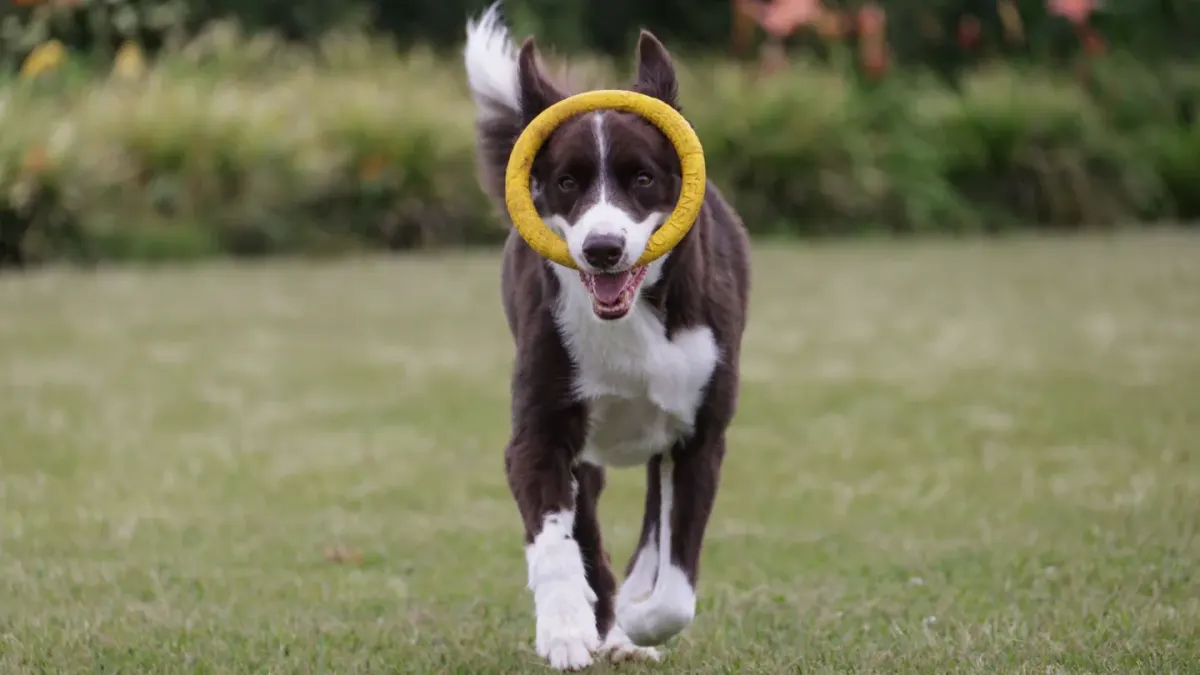
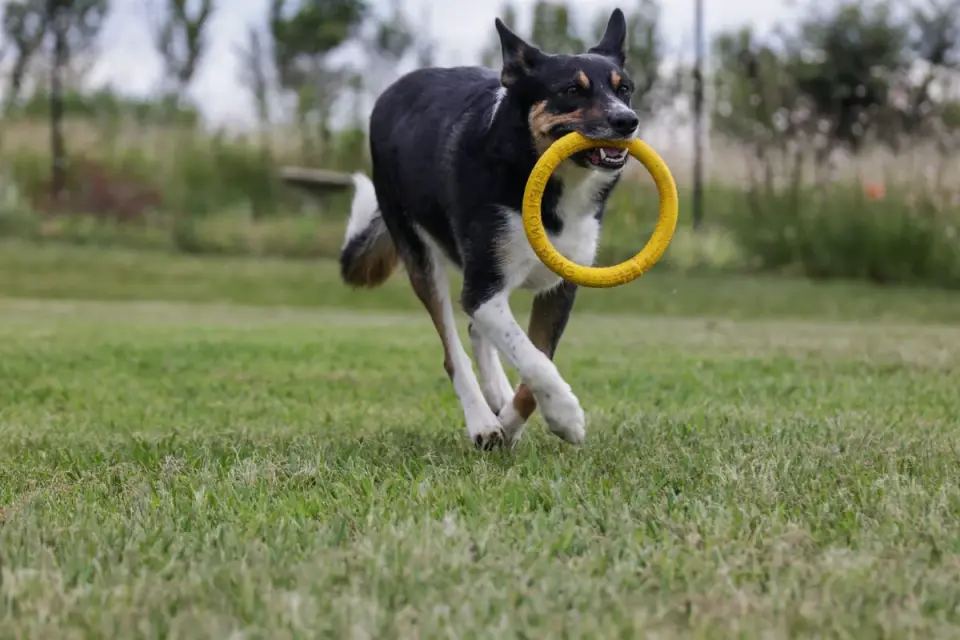
Fetch on hard ground, sudden skids for a Frisbee, dog-park sprint-and-slam play, and downhill running are the highest joint-cost activities for heavy dogs. I am not saying never, but I weigh what that pounding can realistically do to recovery against what slower work gives back in stability.
The comparison I walk owners through is the same one in this fetch versus structured walks breakdown: fetch spikes heart rate and arousal while loading the same joints the same way, rep after rep. A structured walk builds symmetrical muscle, better body awareness, and calmer behavior you can repeat tomorrow without paying for it.
A six-year-old, 110-pound guardian mix made this real for me. His family had tried to tire him with nightly asphalt fetch because he pulled on leash, and by day 10 he was skipping on his right hind leg after hard stops and needing most of the evening to settle. We cut fetch to once a week on grass with only three low throws, replaced the other days with 25-minute sniffy walks plus curb step-ups and gravel-path hill work. His pulling faded once the arousal cycle broke, and the post-play limp stopped driving the schedule.
The strongest counterargument is fair: some big, athletic dogs need to run full out, and holding them back feels wrong. I still land on control first because unconditioned sprinting is what most often creates the soft-tissue injury that limits exercise for months, and muscle built at a walk is what lets a dog sprint safely later.
Build the week around surfaces and recovery
You can do a lot today with surface choice. Grass, dirt trail, rubber matting, and shallow water unload joints while still asking muscles to work. Concrete, slick hardwood floors, icy sidewalks, and steep stairs do the opposite.
I like a simple rotation for healthy adult large breeds: three days of 20- to 40-minute brisk leash walks with 5 minutes of easy warm-up, one day of water work or incline walking if you have access, one day of balance and body-awareness work, and one true sprint-play day kept short and on grass. Keep one full rest or sniff-only day, especially after the hard day. For ideas on splitting free play and on-leash work, this off-leash versus on-leash guide is a practical starting point.
Where does joint nutrition fit? Food therapy and weight control come first because every extra pound multiplies joint load, and no powder changes that math. Supplement science may help support the surrounding structures — for context, researchers reporting in Frontiers in Veterinary Science described chondroitin work as something that “supports healthy synovial fluid homeostasis,” work summarized in the Journal of Veterinary Medical Science found glucosamine could “prevent experimentally induced cartilage degradation in vitro,” and investigators in Nutrients noted that “BMO, GMO, and KO all alleviated paw swelling in rats and reduced serum levels of rheumatoid factor (RF), anti-cyclic citrullinated peptide (anti-CCP) antibody, and pro-inflammatory cytokines such as TNF-α and IL-17.” That is interesting mechanistic context for mobility and recovery, not proof that a chew lets a heavy dog handle more impact.
Watch for the quiet edge case
Not every big dog tells you loudly. The edge case that changes my plan is the stoic senior who still begs for the long hike.
I followed an eight-year-old, 87-pound shepherd type who could still do five weekend miles and looked proud doing it, then spent two days sleeping by the door and hesitating on the three front steps. His owner read the enthusiasm as fitness and the crash as normal aging. We kept the adventure but split it: a 30-minute morning loop Saturday with hill repeats on grass, a 20-minute flat sniff walk Sunday, and two 15-minute weekday strength sessions instead of one long make-up walk after work. By week four, he took those front steps without pausing on three of four mornings, which told us the total was right even though the single big outing looked more impressive.
Use that kind of marker at home: how quickly he rises, whether stairs stay smooth the next day, whether gait stays even after rest. Soreness that lasts beyond 24 hours means you overspent.
That is the whole approach in brief: feed a lean body, strengthen first, choose forgiving ground, dose intensity, and let next-day movement set the next day’s plan.
For related context, read Common Dog Exercise Mistakes Owners Make (And What to Do Instead).
For related context, read Dog Park vs Structured Exercise for Your Dog.
Sources
- Synovial fluid homeostasis study — Frontiers in Veterinary Science
- Glucosamine cartilage degradation study — Journal of Veterinary Medical Science
- Marine oil joint inflammation study — Nutrients